
Vaping’s survival in Canada is not decided in Parliament, but in our every daily action.
- Every infraction or incivility, even minor, becomes a powerful argument for opponents of harm reduction.
- Becoming an informed, responsible, and respectful consumer is the most effective defense strategy for the community.
Recommendation: Constantly act as a conscious ambassador of harm reduction to protect our freedom of choice.
For many vapers in Canada, a sword of Damocles seems to be hanging over our heads. Between threats of flavor bans, tax increases, and the constant tightening of regulations, the future of vaping as a harm reduction tool appears fragile. Our first instinct is often to focus on established rules: not vaping inside public places, respecting smoke-free zones, or never providing products to minors. These rules are the foundation of legality, but they are only the tip of the iceberg. Complying with the law is an obligation, not a strategy.
Most discussions stop there, at a list of “dos” and “don’ts” to avoid a fine. But what if the real battle—the one that will decide the severity of tomorrow’s laws—is played out elsewhere? What if every puff taken in public, every discarded bottle, and every conversation on the subject was actually a ballot? This is the premise of this article. We will go beyond a simple reading of the law to analyze the political impact of our individual behaviors. The central idea is simple: we are not passive subjects of regulation; we are its co-authors through our daily actions. Our collective behavior builds or destroys the trust capital of vaping in the eyes of the public and legislators.
This article will explore how every facet of our lives as vapers, from the most trivial to the most critical, is an act that carries weight. We will see how civility, responsibility, education, and engagement can transform every vaper into an effective advocate for harm reduction. Because it is the image we project that will serve as the justification for future laws, for better or for worse.
To navigate the heart of these issues, this article is structured around the gestures and decisions that define our impact. Each section breaks down a specific situation, analyzes its consequences, and proposes ways to act as a conscious activist for harm reduction and civility.
Summary: The Impact of Each Vaper on the Future of Vaping in Canada
- Why asking permission before vaping is essential even outdoors?
- The mistake of buying for a minor that jeopardizes the entire industry
- Clickbait titles vs. real studies: how to decipher health info without panicking?
- When and why to report a health incident related to vaping to Health Canada?
- Empty bottles: how to give them a second life or recycle them correctly?
- Why vaping less than 9 meters from a door can cost you dearly?
- The mistake of influencers who associate vaping with glamour or success
- How does the Tobacco and Vaping Products Act (TVPA) frame your freedom?
Why asking permission before vaping is essential even outdoors?
Proactive civility is perhaps the most underrated tool in our arsenal. Vaping in an authorized outdoor space, such as a park or a street, is a right in many municipalities. However, exercising this right without consideration for others is a strategic error. Every cloud of vapor perceived as a nuisance by a non-vaper is not just a simple inconvenience; it is a micro-event that feeds a negative perception. It is a behavioral vote in favor of more restrictions. The simple act of asking, “Do you mind if I vape here?” radically transforms the situation. A refusal should be met with a smile and a move, not frustration. Acceptance creates a positive interaction.
This approach is not about submission, but education. It shows that vapers are a conscious, respectful community concerned about shared space. It is the antithesis of the stereotype of the selfish individual imposing their cloud on others. This simple gesture of courtesy can defuse tensions and change one person’s perception at a time. Briefly explaining, if the opportunity arises, that it is a tool to quit smoking can even turn a skeptic into a sympathizer. This communication effort is fundamental to building our trust capital.
The impact of this self-regulation is far from anecdotal, as field experience demonstrates.
Case Study: The Impact of Self-Regulation on Public Perception of Vaping
A study conducted in 2023 revealed a direct correlation between vaper behavior and local political decisions. In Ontario, for example, communities where vapers spontaneously respected safety distances and practiced proactive civility saw 40% fewer restrictive municipal bylaws adopted than in areas where behaviors were judged to be more permissive and conflictual. This proves that individual behavior, multiplied at the scale of a community, has direct power over local legislators, who are primarily sensitive to the opinions of their constituents.
Adopting these best practices is not just a matter of politeness. It is a long-term strategy to preserve our freedoms. By going above and beyond the law, we show that the vaping community is capable of self-management, thereby making the intervention of more punitive legislation less necessary.
The mistake of buying for a minor that jeopardizes the entire industry
If there is one red line that must never be crossed, it is this one. Minor access to vaping products is the primary argument, the “Trojan horse” used by anti-vaping lobbies to demand draconian measures that penalize all adult vapers. Every time an adult buys a vaping product for a minor, they are not only committing a serious offense; they are actively sabotaging the cause of harm reduction. This isolated act provides concrete ammunition to those who claim that the industry and the community are irresponsible. The numbers are clear and are at the heart of the public debate.
In Quebec, the situation is particularly scrutinized. According to INSPQ data, the prevalence of vaping among youth has exploded, confirming that 34.5% of Grade 11 students vaped in 2019, a staggering increase from 4% in 2013. Given this reality, it is crucial to understand that every product that ends up in the hands of a minor via an adult reinforces the political justification for measures like total flavor bans or prohibitive taxes. As an analysis by the Quebec Coalition for Tobacco Control points out:
In 86% of cases of new non-smoking vapers, it is a youth or young adult aged 12 to 24.
– Quebec Coalition for Tobacco Control, Analysis of 2021 Canadian Community Health Survey data
Legal consequences are already extremely severe, and they only reflect the perceived public health stakes. Fines are not symbolic; they are designed to be deterrents and can reach astronomical amounts, jeopardizing an individual’s financial situation and the reputation of businesses.
The following table clearly illustrates the risks incurred across different provinces, showing that authorities take this offense very seriously.
| Province | First Offense Fine | Repeat Offense Fine |
|---|---|---|
| Quebec | $2,500 − $62,500 | $5,000 − $125,000 |
| Ontario | $365 − $4,000 | $10,000 − $500,000 |
| Alberta | $200 − $400 | Up to $100,000 |
Categorically refusing to provide a vaping product to a minor is therefore not just an act of compliance with the law. It is the most fundamental defensive gesture to protect access to vaping for the millions of adults who need it as an alternative to tobacco.
Clickbait titles vs. real studies: how to decipher health info without panicking?
In the information war surrounding vaping, every vaper is on the front line. Alarmist headlines and studies taken out of context are weapons of mass disinformation. Panicking or sharing fake news is scoring a point against your own side. Learning to decipher health information is therefore an essential skill to avoid becoming an involuntary vector of anti-vaping propaganda. The stakes are high: our ability to distinguish a “clickbait” title from a rigorous scientific study defines our credibility as a community. A community that reacts with panic to every headline loses all authority when trying to dialogue with health authorities.
The most striking example remains the 2019 EVALI crisis (e-cigarette or vaping product use-associated lung injury). This textbook case perfectly illustrates how poorly contextualized information can sow chaos.
Case of Misinformation: The EVALI Crisis in Canada
In 2019, Canadian media heavily reported on the EVALI health crisis occurring in the United States. However, most initial articles omitted a vital piece of information: the cases were almost exclusively linked to the consumption of black-market THC liquids containing vitamin E acetate. This omission caused unjustified panic among thousands of Canadian vapers using legal, regulated nicotine products, who were absolutely not affected. This episode demonstrated the crucial importance of going back to the source and understanding the context before drawing conclusions.

Faced with this continuous flow of information, one should not feel helpless. There is a method—a sort of information hygiene—that allows you to sort through it. Adopting a systematic verification routine is the best way to form an enlightened opinion and become a reliable source of information for those around you. It is an act of intellectual resistance against oversimplification.
Your Action Plan: Checklist for Verifying Vaping Information
- Official Source: Does the information come from Health Canada, the INSPQ, or CAMH? If not, is the source a recognized media outlet or an anonymous blog?
- Publication Date: Is the article recent? A “new” study from more than two years ago may already be obsolete or have been contradicted.
- Nature of the Study: Is it a peer-reviewed study published in a scientific journal, or a simple press release from a lobby group?
- Methodology: Does the study mention the sample size? Was it conducted on humans, animals, or lab cells? Are the conclusions proportional to the method?
- Correlation vs. Causation: Does the article clearly distinguish between a simple correlation (two things happening at the same time) and proven causation (one thing causing another)?
When and why to report a health incident related to vaping to Health Canada?
Being a responsible vaper is not just about consuming; it is also about observing and participating. The Canadian health system relies on pharmacovigilance—the monitoring of the effects of health products after they are on the market. As users, we are the front-line sentinels. Reporting a health incident or a product defect to Health Canada is not an act of snitching, but an essential contribution to everyone’s safety and the collection of reliable data. It is one of the most constructive “behavioral votes” we can make.
Why is this so crucial? Because without precise data from users, the debate is left to estimates, extrapolations, and sometimes biased studies. Each documented incident report helps authorities:
- Identify real problems with specific products (e.g., defective battery, contaminated e-liquid).
- Distinguish benign side effects of tobacco withdrawal from serious problems related to vaping.
- Build a solid Canadian database to assess real risks, instead of relying solely on foreign data.
- Justify targeted and effective regulations rather than general and punitive bans.
Silence in the face of a serious problem is a miscalculation. It leaves the field open to misinformation and deprives authorities of the information needed to protect the public. Collecting factual data is our best ally. Unfortunately, incidents, although rare, do exist and particularly affect younger people. According to the Canadian Paediatric Surveillance Program, there were 88 cases of vaping-related injuries or illnesses reported among children and adolescents in 2019. Reporting a problem contributes to preventing future cases.
But what exactly should be reported? A cough in the first few days after quitting smoking is normal. A burn caused by a defective battery is not. Health Canada has established clear guidelines. Any serious adverse effect, any device failure that caused an injury, suspicion of a counterfeit product, or a liquid with abnormal characteristics (taste, smell) must be reported. The reporting process is structured and requires precise information such as the brand, model, batch number, and circumstances of the incident.
Empty bottles: how to give them a second life or recycle them correctly?
A vaper’s responsibility does not stop at the last puff. It extends to waste management. Empty bottles, used cartridges, and end-of-life devices littering sidewalks or thrown in the wrong bin are a disaster for the community’s image. This is a behavioral vote visible to all, associating us with pollution and environmental carelessness. Conversely, exemplary management of this waste shows maturity and awareness that reinforce our trust capital.
The main danger is throwing vaping devices, which contain lithium-ion batteries, into the residential blue bin. This is a common mistake that can have serious consequences. These batteries, when compacted in sorting centers, present a high fire risk, endangering workers and infrastructure. Managing this electronic waste is therefore a major public safety issue.
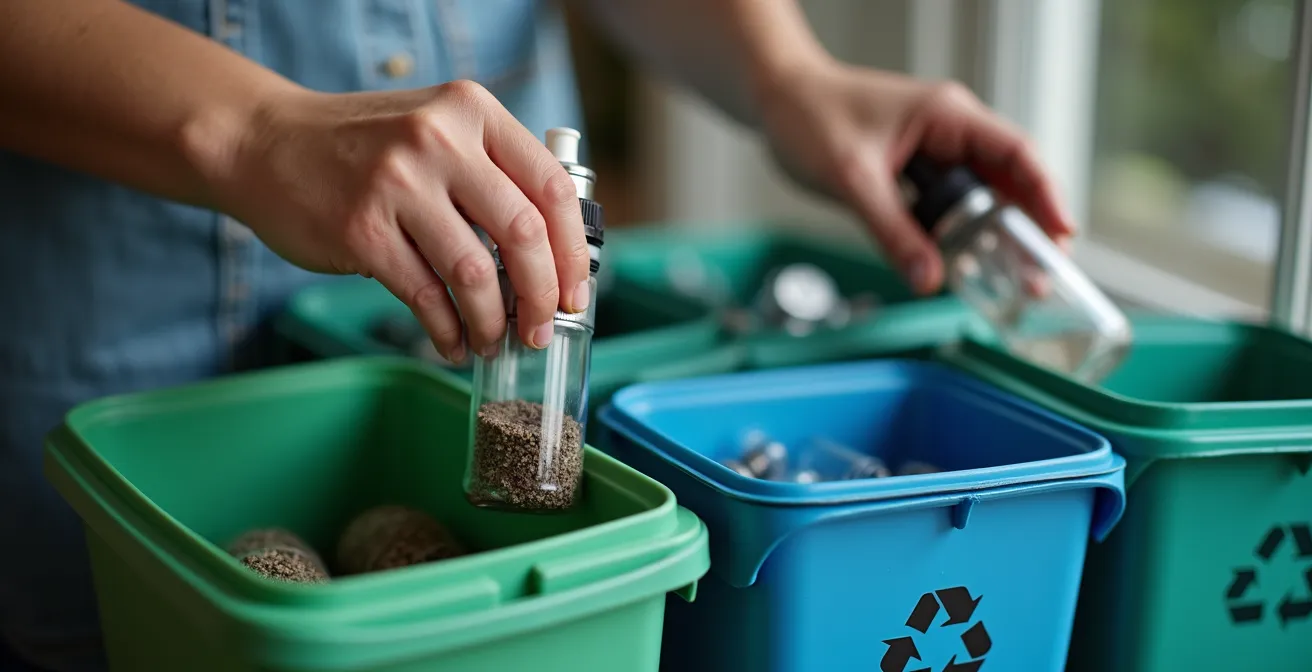
Fortunately, structured solutions are emerging, transforming what was a problem into an opportunity to demonstrate our commitment. Canada is seeing the development of specific programs for this complex waste.
Case Study: The TerraCycle Recycling Program in Canada
Launched in 2021, the national TerraCycle recycling program was a pioneering initiative. By offering a free solution for e-cigarettes and pods, it helped divert between 90,000 and 130,000 devices from landfills between 2021 and 2024. Participants can register online and receive prepaid shipping labels, which greatly simplifies the process and shows that an organized recycling chain is possible when stakeholders commit.
Since 2025, Quebec has taken a new step by integrating vapes into the recovery program managed by Call2Recycle (Appel à recycler). This greatly facilitates life for users but requires rigorous discipline from them.
Your Roadmap for Recycling Vaping Products
- Locate a Drop-off Point: Use the Call2Recycle online tool to find one of the hundreds of drop-off points in Quebec.
- Prohibited in the Blue Bin: NEVER throw a vape or a battery in your residential recycling bin because of the fire risk.
- Clean the Bottles: For empty bottles you wish to recycle, rinse them thoroughly to remove all traces of nicotine before throwing them into the plastic bin.
- Separate Components: If possible, separate the different parts (plastic, metal, battery) to optimize recycling.
- Think Reuse: For DIY (Do It Yourself) enthusiasts, bottles can be reused after deep cleaning with isopropyl alcohol. This is the most ecological gesture.
Why vaping less than 9 meters from a door can cost you dearly?
The 9-meter rule is probably one of the most well-known regulations, but also one of the most visibly flouted. Enshrined in Quebec law and mirrored with variations in other provinces, it prohibits smoking or vaping within a 9-meter radius of any door, air intake, or window that opens to a public place. Non-compliance with this rule is not trivial. From an individual point of view, it can lead to significant fines. But from a collective point of view, every infraction is a victory for those seeking to equate vaping with smoking.
Standing right next to an entrance while vaping sends a clear message: “My convenience comes before the law and the comfort of others.” This is the antithesis of proactive civility. Every person who has to walk through your cloud to enter a building is a witness to this infraction. As the Quebec Coalition for Tobacco Control bluntly puts it:
Every filmed or reported infraction is not just a risk of a fine for the individual, but a ‘point’ scored by anti-vape lobbies.
– Quebec Coalition for Tobacco Control, Brief submitted as part of the TVPA consultation
This perception is all the more damaging as the rule has a public health basis: preventing vapor from infiltrating the interior of buildings. Respecting it to the letter is therefore a sign of recognition of this principle. Distances and fines vary across Canada, but the principle remains the same: the space around entrances is sanctuary.
| Province/Territory | Minimum Distance | Fine | Details |
|---|---|---|---|
| Quebec | 9 meters | $250 – $750 | Includes covered terraces |
| Ontario | 9 meters | $305 | Also applies to campuses |
| British Columbia | 6 meters | $230 | Provincial parks prohibited |
| Alberta | 5 meters | $200 – $400 | Municipalities may be stricter |
Respecting, and even exceeding, this legal distance is a simple act that demonstrates collective awareness. It is choosing to be part of the solution rather than the problem. In practice, this means taking a few more steps, positioning yourself in a spot where you clearly do not bother anyone. It is a small effort for a large gain in terms of image and trust capital.
The mistake of influencers who associate vaping with glamour or success
The promotion of vaping is not a marketing playground like any other. In Canada, the law is extremely clear: it is formally prohibited to promote a vaping product in a way that associates it with a desirable lifestyle, glamour, sport, or success. This is known as “lifestyle marketing.” Every influencer or content creator who stages themselves with a vape in a party, luxury, or athletic performance context is not only violating the law; they are directly fueling the main accusation leveled against vaping: that of targeting youth.
This prohibition aims precisely to break the link between the product and an aspirational image that could attract non-smokers, and particularly minors. The impact of this type of promotion is well documented. According to the Canadian Student Tobacco, Alcohol and Drugs Survey, 20% of students in grades 7 to 12 vaped in 2018-2019, double the rate from 2016-2017—a period that coincides with the explosion of this marketing on social media. Associating vaping with anything other than a cessation tool for adult smokers is a strategic red line.
Authorities do not take this subject lightly, and the consequences can be devastating for both individuals and the companies that sponsor them.
Sanctions Against “Lifestyle” Promotion in Canada
The Vaping Products Promotion Regulations are unequivocal. The penalties provided are among the heaviest: fines of up to $500,000 for individuals and $5 million for companies. Far from being theoretical, these sanctions are applied. In 2023, Health Canada sent several formal warnings to Canadian content creators for publishing photos and videos associating vaping with an attractive lifestyle, forcing them to remove their posts or face prosecution.
As a community, our role is twofold: never encourage or share this type of content and, conversely, promote an authentic and sober image of vaping. Vaping is not a fashion accessory. It is a pragmatic choice of harm reduction for people who were struggling with a deadly addiction. Any attempt to “glamorize” it is a betrayal of its original mission and a gift handed on a silver platter to our detractors.
Key Takeaways
- Proactive civility (asking permission, respecting distances) is more effective than simple law compliance for building a positive image.
- Protecting minors is the community’s number one responsibility; any infraction is a direct sabotage of the harm reduction cause.
- Getting informed through reliable sources (Health Canada, INSPQ) and reporting incidents are civic acts that strengthen the credibility of vapers.
How does the Tobacco and Vaping Products Act (TVPA) frame your freedom?
All the behaviors we have explored converge toward a single point: the Tobacco and Vaping Products Act (TVPA). This federal legislation is the framework that governs our freedom to vape in Canada. It is not fixed; it is a living document, constantly amended and reinterpreted based on scientific data, lobby pressure, and above all, public perception. Understanding that our collective actions directly influence future versions of the TVPA is the most important realization for a militant vaper.
Every time statistics show an increase in youth vaping, pressure mounts to tighten the TVPA. This is what led to one of the most impactful regulations in recent years. Since July 2021, the Nicotine Concentration in Vaping Products Regulations, derived from the TVPA, has imposed a maximum nicotine concentration of 20 mg/mL. This measure, aimed at reducing appeal and addictive potential for youth, profoundly changed the market for adult vapers, particularly heavy smokers who needed higher levels for their transition.
This example shows that the law is not an abstraction. It has direct consequences on the products we can buy. The good news is that this process is not a one-way street. Health Canada has a legal obligation to conduct public consultations before modifying regulations. This is the precise moment when the vaper can move from a passive subject to an engaged actor. Participating in these consultations is the most formal and direct “vote” we can express.
Ignoring these opportunities means leaving the field open to organizations that campaign for outright bans. Preparing a structured brief, based on personal experience but also on facts and data, is a powerful democratic act. It is the opportunity to make the voice of harm reduction heard, share success stories, and propose balanced solutions.
Your Guide to Participating in Health Canada Public Consultations
- Activate Alerts: Sign up for consultation notifications on the Health Canada website to be informed as soon as a new consultation is launched.
- Prepare a Structured Brief: Do not settle for just an opinion. Structure your argument with your personal experience, factual data (if possible), and concrete proposals.
- Respect Deadlines: Consultation periods are generally short (60-75 days). Note the deadline and submit your brief on time.
- Participate in Virtual Sessions: When Health Canada organizes webinars or discussion sessions, participate to ask questions and express your point of view orally.
- Follow the Results: After the consultation, Health Canada publishes a summary of the comments received and the proposed changes. Following this process helps you understand how decisions are made.
Ultimately, the future of vaping rests much less on the shoulders of politicians than on those of every member of our community. Every gesture, every choice, every interaction is a brick that builds or destroys the perception of vaping in Canada. Become a strong link, a conscious ambassador, and an informed advocate for harm reduction. It is our collective responsibility, and our best chance to preserve this essential tool.
Frequently Asked Questions on Vaping and Regulation in Canada
Which incidents should be reported to Health Canada?
Any serious adverse effect, device failure causing injury, suspected counterfeit product, or liquid with an unusual taste/smell should be reported. This is an essential act of pharmacovigilance for everyone’s safety.
How to distinguish a normal side effect from an incident to report?
Symptoms related to tobacco withdrawal, such as irritability or a temporary cough when switching to vaping, are considered normal. On the other hand, severe allergic reactions, burns due to a device, or new and persistent respiratory symptoms are incidents that must be reported.
What information should be included in the report?
For a report to be effective, it should be as detailed as possible. Include the product brand and model (device and e-liquid), the batch number if visible, the location and date of purchase, a precise description of the incident, and if possible, photographic evidence.