Summary:
- Change your coil every 1 to 2 weeks on average, or imperatively at the first sign of flavor alteration.
- Highly sweetened e-liquids (containing sucralose) accelerate degradation and can generate harmful by-products when heated.
- Patient priming and rigorous cleaning are not options, but fundamental steps for respiratory hygiene.
- In Canada, recycling programs exist: used coils must be taken to an eco-center and not thrown into domestic recycling bins.
That sudden, sharp, and irritating taste that turns an enjoyable puff into an unpleasant experience of “wet cardboard”: every vaper has known it. It is the universal signal that a coil has reached the end of its life. Most guides simply recommend changing it every one to three weeks. While this advice is a good starting point, it remains dangerously superficial for anyone concerned about their respiratory health. Maintaining your electronic cigarette is much more than a matter of comfort or flavor; it is a fundamental hygiene issue.
As a respiratory hygienist, my approach is different. It is not just about knowing *when* to change your coil, but understanding *why* a used coil represents a risk. The true key is not following a rigid schedule, but recognizing the signs of chemical and physical degradation to prevent the inhalation of potentially harmful by-products. A clogged coil is not just dirty; it is the site of thermal reactions that can alter the components of your e-liquid.
This article will provide you with a rigorous maintenance protocol, not to optimize flavors, but to minimize the potential toxic load of your practice. We will analyze the root causes of wear, the impact of additives like sucralose, preventive maintenance techniques, and proper recycling practices specific to the Canadian context, so that every inhalation is as safe as possible.
To effectively navigate through this preventive health guide, here are the essential points we will cover. Each section is designed to give you the tools necessary for a more informed and safer vaping practice.
Summary: Coil Replacement Protocol for Healthier Vaping
- Why does your strawberry suddenly taste like wet cardboard?
- Drops in the center and patience: The ritual that doubles your coil’s life
- Sucralose: Why “dessert” liquids kill your coils in 3 days?
- The error of flooding a new coil that causes hot spitback
- Where to dispose of atomizer heads made of metal and soiled cotton?
- Burnt taste or loss of vapor: What is the first warning sign?
- Tobacco vs. Vape: Which one finally stops yellowing your teeth and dentures?
- How to deep clean your tank to switch from mint to tobacco?
Why does your strawberry suddenly taste like wet cardboard?
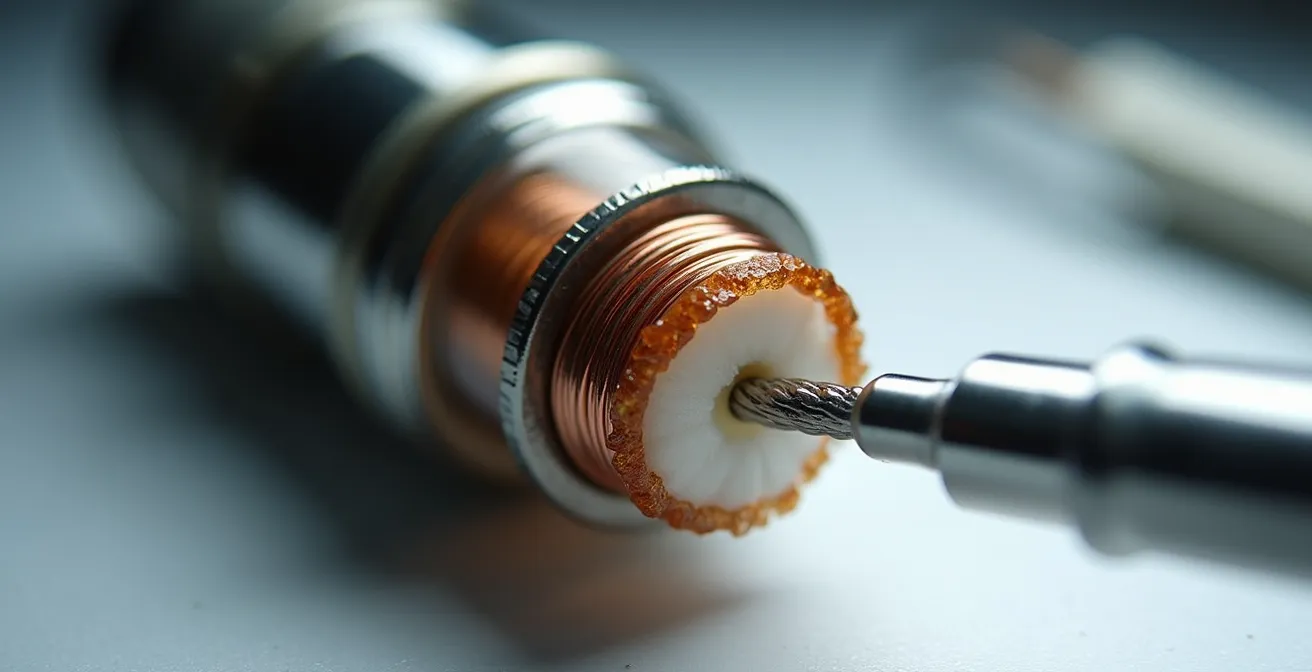
This unpleasant change in taste, often described as a “burnt” or “wet cardboard” flavor, is not a simple inconvenience. It is the most obvious symptom of your coil’s degradation and a warning signal for your respiratory health. This phenomenon, called a “dry hit,” occurs when the cotton inside the coil is no longer sufficiently saturated with e-liquid before the heating element warms up. The metal then directly heats the dry cotton fiber, burning it and releasing acrid compounds that you inhale.
Beyond the occasional dry hit, progressive flavor alteration is due to the accumulation of residues. With each heating cycle, small amounts of sugars (found in flavorings, especially sucralose) and vegetable glycerin caramelize on the resistive wire. This is a form of Maillard reaction, similar to what browns toast. These carbonaceous deposits accumulate, insulate the coil, and eventually “cook” instead of vaporizing the liquid, deeply altering flavors and potentially generating undesirable by-products. This is why the “strawberry” flavor turns into an indefinable, chemical taste.
Generally, manufacturers and experts agree that a coil should be changed every 1 to 2 weeks depending on usage frequency and the type of liquid. However, this is only an average. An intensive vaper using very sweet liquids can destroy a coil in two or three days. The most reliable indicator is not the calendar, but your senses: from the first perception of an altered taste, replacement becomes a sanitary necessity.
Drops in the center and patience: The ritual that doubles your coil’s life
The longevity and safety of a new coil do not depend on luck, but on a crucial initial protocol: priming. Skipping this step or rushing it is guaranteed to prematurely burn the cotton, causing a “dry hit” from the first use and making the coil immediately unusable and potentially harmful. Priming consists of ensuring that the cotton is perfectly and uniformly saturated with e-liquid before receiving any heat.
A rigorous priming technique is the first gesture of preventive hygiene. It avoids cotton combustion and ensures clean vaporization from the start. The illustration below shows the key gesture: direct application of e-liquid drops onto the visible cotton of the new coil.
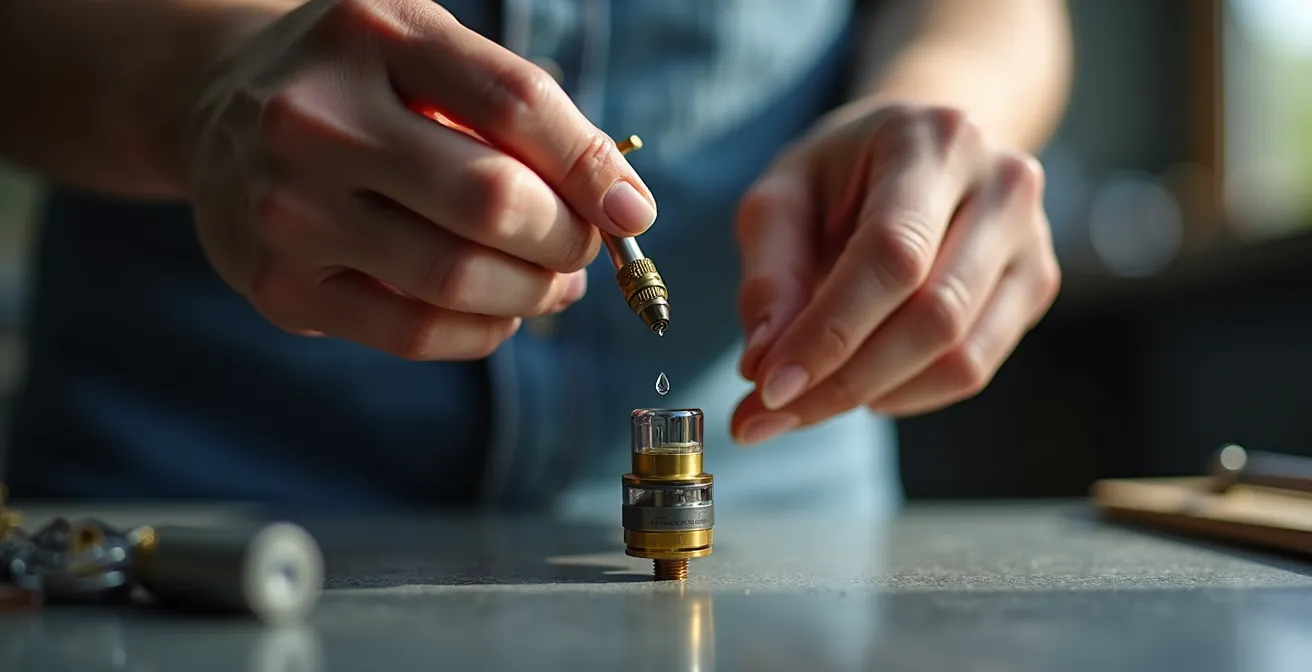
As seen here, this precise action ensures that the heart of the wick is soaked even before insertion into the tank. A properly maintained and primed coil can, according to feedback from experienced users, vaporize between 30 and 40 ml of e-liquid before showing signs of fatigue. It is an investment of a few minutes that has a direct impact on the lifespan, performance, and, above all, the safety of your equipment.
Your priming protocol, adapted to the Canadian climate:
- Acclimatization: In winter, let your equipment and e-liquid reach room temperature before starting. A liquid that is too cold and viscous penetrates the cotton poorly.
- Direct impregnation: Pour a few drops of e-liquid directly into the center of the coil, on the visible cotton, until it appears thoroughly damp.
- Filling and patience: Fill your tank and wait. The pause time is critical: 5 minutes for 50/50 liquids (nicotine salts), and at least 10 minutes for high VG liquids (sub-ohm).
- Gradual start: Begin with a few short puffs at a lower power setting than you usually use. This allows the impregnation to finalize gently.
Sucralose: Why “dessert” liquids kill your coils in 3 days?
If you are a fan of gourmet flavors like “pastry,” “caramel,” or “sweet drinks,” you have likely noticed that your coils have a much shorter lifespan. The main culprit is a common additive: sucralose. Although it offers intense sweetening power without calories, its impact on vaping hardware is deleterious and raises health concerns.
Sucralose is particularly heat-unstable. During vaporization, it doesn’t just caramelize; it chemically decomposes. This decomposition is responsible for the rapid creation of a thick black deposit, similar to tar, which literally suffocates the cotton and the resistive wire. This clogging is much faster and more aggressive than that caused by natural sugars or vegetable glycerin alone. In a few days, or even hours, a new coil can be completely rendered useless.
Beyond the material aspect, the thermal decomposition of sucralose is concerning from a toxicological standpoint. As highlighted by scientific research, this reaction can generate undesirable compounds. A publication in the journal Chemical Research in Toxicology warns:
Sucralose decomposes during vaporization, producing potentially toxic compounds such as aldehydes and organochlorine compounds.
– Chemical Research in Toxicology, Study on sucralose decomposition
This information is vital. It means that using highly sweetened liquids with sucralose not only reduces the life of your coil but can also increase the toxic load of the inhaled vapor. For a health-conscious vaper, limiting or avoiding e-liquids containing sucralose is a logical precautionary measure.
The following table clearly illustrates how the type of flavor, often linked to the amount of sugars and additives, influences the longevity of your hardware.
| Type of E-liquid | Impact on Coil | Relative Lifespan |
|---|---|---|
| Pure menthol (unsweetened) | Very little clogging | 100% (Reference) |
| Low-sugar fruit flavors | Low clogging | 90-100% |
| Sweet gourmet flavors | Significant clogging | 70-80% |
| Macerated tobaccos | Variable clogging | 60-90% |
| Very “cool/icy” flavors | Rapid fiber degradation | 50-70% |
The error of flooding a new coil that causes hot spitback
In the effort to prime a coil well, there is a pitfall just as problematic as the “dry hit”: over-saturation, or “flooding” the coil. This phenomenon, which manifests as gurgling sounds upon inhalation and projections of hot liquid into the mouth (“spitback”), is not only unpleasant but also a sign of malfunction.
Spitback occurs when there is an excess of e-liquid on the coil. Instead of vaporizing instantly upon contact with the hot wire, the surplus liquid boils, projecting fine hot droplets through the chimney to the drip tip. This problem is particularly common with pod systems, very popular in Canada for nicotine salt use, which are often more sensitive to excessive saturation. The balance is delicate: the cotton wicks must be airy enough to let the liquid flow but dense enough to avoid flooding.
A flooded coil is not permanently lost. It is possible to correct the situation with a simple technique, though it must be done carefully. The goal is to evacuate the excess liquid from the atomization chamber to restore normal operation. Here is the protocol to follow:
- Secure the hardware: Remove the clearomizer or pod from the battery to avoid accidental firing.
- Prepare for evacuation: Firmly wrap a piece of paper towel around the mouthpiece (drip tip).
- Evacuate the excess: Hold the clearomizer with the tip pointing downward and shake it vigorously up and down, as you would with an old mercury thermometer. The paper towel will absorb the expelled liquid.
- Repeat and clean: Repeat the operation 3 to 4 times. Then clean the battery and clearomizer contacts before reassembling.
- Resume gently: Vape again, starting with slightly reduced power to stabilize vaporization.
Where to dispose of atomizer heads made of metal and soiled cotton?
Waste management is an often-overlooked aspect of vaping practice, but it is crucial from an environmental standpoint. A used coil is a complex waste item. It is composed of several materials: metal (kanthal, stainless steel, nickel), organic cotton soiled with glycerin, propylene glycol, and nicotine, and sometimes silicone gaskets. Under no circumstances should it be thrown into the domestic recycling bin.
In Canada, the recycling chain for vaping products is gradually becoming organized. Used coils are considered small metal objects and must be taken to a municipal eco-center (waste drop-off site). There, they will be handled within the metal recycling stream. It is important not to mix them with electronic waste, as they do not contain complex electronic components unless it is a sealed cartridge with an integrated battery.
Quebec, in particular, has made notable progress. Under the “Call2Recycle” program recognized by RECYC-Québec, a major effort is being made to collect vaping devices. A Radio-Canada report states that nearly 200 drop-off points have been designated in Quebec for vaping products since January 2025. Although this program primarily targets devices containing a battery, it reflects growing awareness and facilitates access to sorting infrastructure.
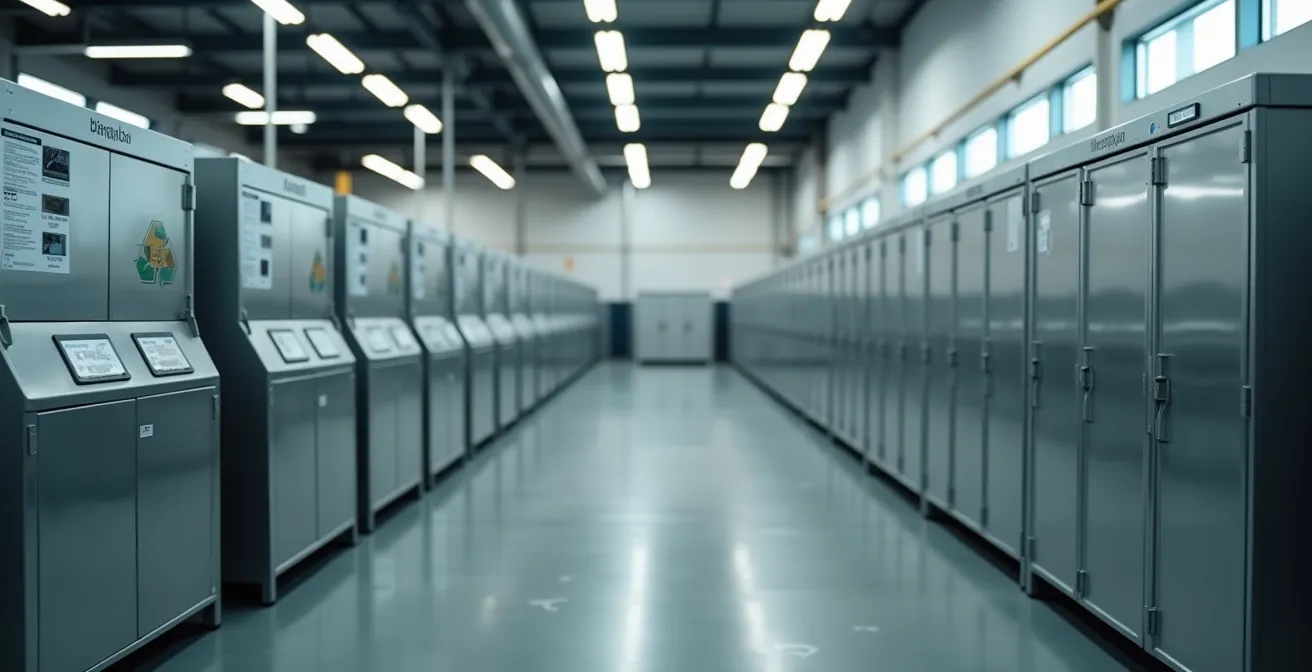
Some specialized vape shops in Canada have also set up, on their own initiative, collection bins for used coils. Inquiring with your local retailer is an excellent step. By adopting these best practices, every vaper can reduce the environmental impact of their consumption.
Burnt taste or loss of vapor: What is the first warning sign?
Identifying the first signs of coil wear is the most important skill for ensuring a healthy practice. Waiting for a sharp, acrid burnt taste is already too late; at that stage, you have already inhaled cotton combustion by-products. The first warning signal is often much more subtle: an alteration of aromas and a loss of vapor density.
When your usual e-liquid suddenly seems bland, or the sweet or fruity notes are less present, it is a sign that the coil is clogged. Caramelized residues accumulated on the resistive wire act as an insulator. They prevent efficient vaporization and “cook” the liquid instead of transforming it into an aerosol. Vapor production decreases, becomes less dense, and may take on a slightly dry taste, a precursor to the burnt taste.
Another often-underestimated diagnostic tool is visual inspection. On most modern clearomizers, it is possible to glimpse the cotton through the small liquid intake windows on the side of the coil. New cotton is a pristine white. Cotton at the end of its life will be visibly browned or even blackened by residue buildup. This simple inspection allows for the detection of advanced degradation even before the taste becomes unbearable. If the cotton is dark, it is time to change the coil, even if the taste is still acceptable.
In summary, the order of appearance of the signals is generally as follows:
- Progressive decrease in flavor restitution.
- Drop in vapor production and density.
- Appearance of a dry and slightly sharp taste upon inhalation.
- The frank burnt taste (dry hit), which is the ultimate signal never to ignore.
Tobacco vs. Vape: Which one finally stops yellowing your teeth and dentures?
One of the aesthetic advantages often cited when switching from tobacco to electronic cigarettes is the reduction in tooth yellowing. Combustible tobacco releases tar and thousands of chemicals that deposit on tooth enamel, causing a stubborn brown or yellow stain. The vapor from an electronic cigarette is free of tar and carbon monoxide. Consequently, its impact on tooth coloration is significantly lower than that of traditional cigarettes.
However, it is inaccurate to say that vaping has absolutely no effect. Two components can play a role, albeit a minor one: nicotine and the dyes present in some e-liquids. Nicotine, when exposed to oxygen, has a natural tendency to yellow. While its effect is much less pronounced than that of tar, high consumption can contribute to a slight tint over the long term. Additionally, e-liquids with dark flavors like coffee, cola, or certain macerated tobaccos contain dyes that can also deposit on the teeth.
This health and aesthetic issue fits into a broader public health context, especially among young people. According to a study by the Institut national de santé publique du Québec (INSPQ), daily vaping is a concerning reality. The institute reports that 33% of adolescents and 39% of young adults who vaped in the last 30 days in 2020 did so on a daily basis. To maintain good oral hygiene, a few simple steps are recommended:
- Prioritize clear or lightly colored e-liquids.
- Avoid excessive consumption of very dark flavors (coffee, cola).
- Rinse your mouth with water after long vaping sessions.
- Maintain rigorous dental hygiene: brush twice a day and use dental floss.
- Consult a dental hygienist for professional cleaning every 6 to 12 months.
Points to Remember
- The frequency of changing your coil is dictated by chemistry: sweetened e-liquids (sucralose) are the number one enemy of their longevity.
- Patient priming and meticulous cleaning are not options, but the pillars of a risk-reducing vaping practice.
- Recycling is a civic duty: in Canada, used coils must be taken to an eco-center, never to the domestic recycling bin.
How to deep clean your tank to switch from mint to tobacco?
Changing e-liquid flavors, especially when switching from a powerful aroma like mint to a more subtle one like classic tobacco, can be a disappointing experience. Residual flavors, or “ghosting,” can persist in the tank and pollute the taste of the new liquid for several days. A simple rinse with water is often insufficient. For a clean transition and perfect hygiene, a deep decontamination protocol of the clearomizer is necessary.
This procedure does not only serve to improve taste; it helps eliminate viscous vegetable glycerin residues and deposits that can accumulate in the smallest corners of the tank. It is an act of maintenance that ensures every component is clean and functional. In Quebec, where vaping is widespread among young adults with, according to 2021 INSPQ data, 16% of 20-24 year olds vaping, mastering these hygiene steps is essential.
Here is a complete method to decontaminate your tank and start fresh on a neutral basis. For optimal cleaning, using an ultrasonic cleaner (often sold for jewelry) is the best solution, and affordable models are available at retailers like Canadian Tire.
- Full Disassembly: Unscrew all parts of your clearomizer (base, glass tank, chimney, top cap). Remove and discard the used coil.
- Alcohol Bath: Submerge all metal and glass parts in an isopropyl alcohol bath (90% or more) for about 30 minutes. Alcohol is an excellent solvent for greasy PG/VG residues.
- Mechanical Cleaning: Use a small soft brush (an old toothbrush works well) to gently scrub threads and gaskets where residue builds up most.
- Thorough Rinsing: Rinse each piece abundantly under hot water. Be careful of thermal shock on the glass in winter; let the pieces warm up gradually.
- Meticulous Drying: Dry each component with a clean paper towel, then let them air dry for at least one hour so that all traces of moisture and alcohol evaporate completely.
To protect your airways and guarantee a healthy experience, adopting these maintenance protocols is not an option, but a necessity. Put this rigorous guide into practice today.
Frequently Asked Questions on Vape Coil Maintenance
Where can I recycle my used coils in Canada?
Coils must be taken to a municipal eco-center or a collection point for metal objects. Never throw them in the domestic recycling bin.
Does the new Quebec program accept coils?
The “Recyclez Vos Vapoteuses” program focuses on devices with batteries. Coils alone should be taken separately to eco-centers.
Are there in-store take-back programs?
Some Canadian vape shops have established voluntary collection bins. Check with your local retailer.