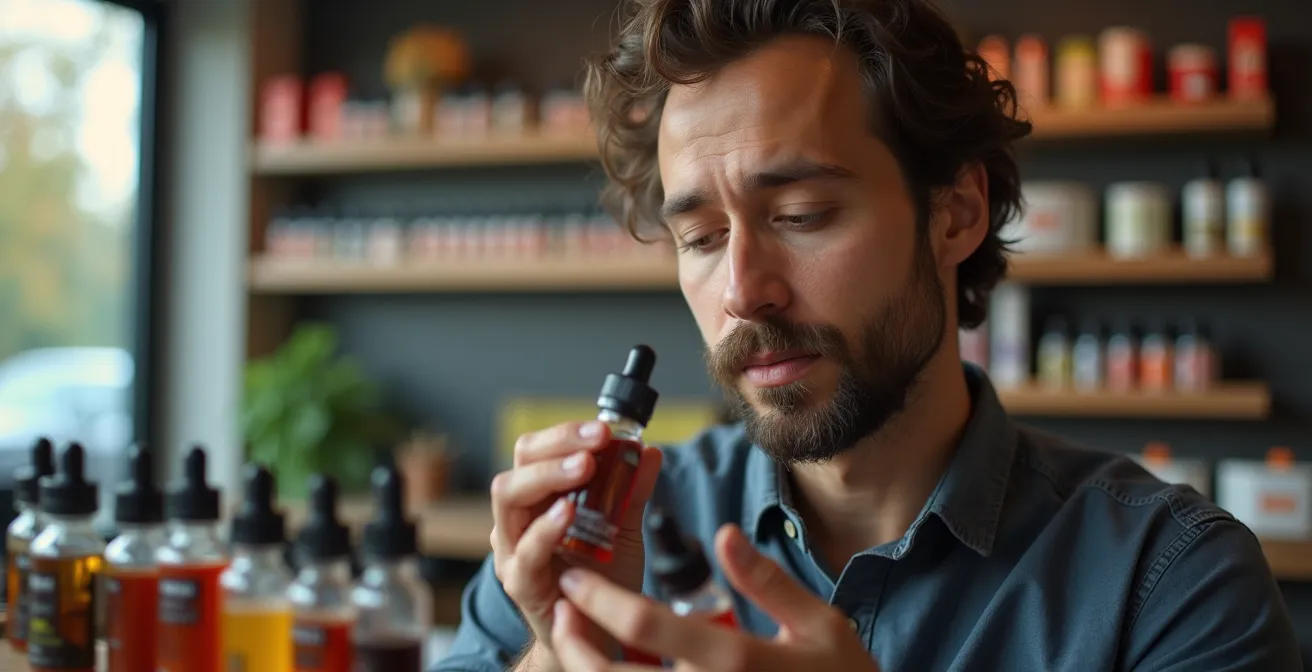
Identifying a Propylene Glycol (PG) sensitivity is not a simple allergy, but a diagnosis that must rule out the effects of tobacco withdrawal and take into account the Canadian climatic context.
- PG symptoms (dry throat, irritation) can be confused with those of quitting smoking (coughing, mouth ulcers).
- E-liquid viscosity, which is highly sensitive to Canada’s extreme temperatures, is a key factor in leaks and irritation.
Recommendation: Before concluding you have an intolerance, proceed by elimination by testing different PG/VG ratios and adapting your liquid to the season.
You’ve swapped traditional cigarettes for vaping, but persistent throat irritation, redness, or a dry cough is ruining your experience. Your first instinct, and that of many forums, is to point the finger at a well-known culprit: Propylene Glycol, or PG. This molecule, a pillar of many e-liquids for its ability to carry flavors and simulate the “throat hit” of a cigarette, is often accused of being the source of all troubles. You might be advised to switch to 100% Vegetable Glycerin (VG) liquid, hoping the problem disappears like magic.
However, as a specialized allergist, I can state that this approach is often too simplistic. What if the real cause of your discomfort wasn’t the PG itself, but a complex interaction of several factors? Imagine your body is simply reacting to the abrupt cessation of tobacco. Or perhaps, the physics of your e-liquid is being disrupted by Canada’s harsh winters and humid summers—a phenomenon that is often underestimated. True PG intolerance does exist, but it is rarer than people think and requires a proper differential diagnosis.
This article proposes a rigorous investigative approach. We will first learn to distinguish the symptoms of PG sensitivity from the very similar symptoms of tobacco withdrawal. Next, we will explore alternatives like Vegetol and VG in detail, analyzing their specific behavior within the Canadian climate. Finally, we will demystify certain roles attributed to PG to allow you to make an informed choice based on science and your personal feelings, rather than preconceived ideas.
To guide you through this process, this article is structured to answer each question progressively. Explore the different facets of this issue to find the solution that best suits you.
Summary: Distinguishing PG Intolerance from Other Factors and Finding the Right Alternative
- Redness or irritated throat: Is it PG or quitting smoking?
- Vegetol vs PG: Is the bio-sourced alternative truly less irritating?
- Why are flavors more precise in a PG-rich base?
- The mistake of leaving your vape in the sun which liquefies PG and causes leaks
- Antimicrobial properties: Does PG really sanitize the vapor?
- How PG captures water from your mouth and how to remedy it?
- Canadian Winter: Why prioritize more PG when it’s -15°C?
- How VG transforms your vapor’s texture into velvet?
Redness or irritated throat: Is it PG or quitting smoking?
The first reflex when facing irritation is to blame the product. However, in the context of switching to vaping, another major phenomenon is at play: tobacco withdrawal. The cilia of your respiratory system, numbed by years of smoking, wake up and start functioning again. This natural “cleaning” often causes a wet cough, throat hypersensitivity, and sometimes even mouth ulcers—symptoms that can appear up to a week after quitting. These are easily confused with a reaction to PG, which also manifests as a dry throat and tingling.
The key is therefore to perform a differential diagnosis. Symptoms related to PG generally appear very quickly, from the first few puffs, while withdrawal symptoms are more progressive. One Quebec vaper reported heart palpitations and general malaise on a specialized forum after several weeks of vaping with a 70% PG liquid. After receiving advice in a shop, switching to a 70% VG liquid resolved his problems. This case illustrates that symptoms can vary and that a simple self-assessment is not always enough.
To see things more clearly, you must be methodical. Observe the chronology: did the symptoms appear immediately or after several days? If you stop vaping for 48 hours, does the irritation drastically decrease? If so, PG is a credible suspect. If symptoms persist (especially the cough), it is more likely your body working to detoxify from tobacco.
Vegetol vs PG: Is the bio-sourced alternative truly less irritating?
If PG is indeed the source of your discomfort, several alternatives are available. The best known is Vegetable Glycerin (VG), but another molecule is gaining popularity: Vegetol (or 1,3-propanediol). Unlike PG (1,2-propanediol) derived from petrochemicals, Vegetol is obtained through the bio-fermentation of plant materials such as corn or rapeseed. This “green” origin is often highlighted, but its main advantage lies in its safety profile: it is reputed to be non-irritating and non-allergenic. Compiled data indicates that approximately 4% of the global population is allergic to propylene glycol, making these alternatives indispensable for some vapers.

Vegetol has a viscosity similar to PG, making it compatible with most vaping hardware and ensuring excellent flavor restitution. It offers a satisfying throat hit, often smoother than PG but more pronounced than VG. However, its availability in Canada remains limited compared to PG and VG, which are found everywhere. The other option is “100% VG” e-liquid. Very low in irritation, it produces dense vapor but alters the flavor of aromas more and, due to its high viscosity, clogs coils faster and is not suitable for all clearomizers.
The following table summarizes the characteristics of each compound to help you make an informed choice.
| Characteristic | PG (1,2-propanediol) | Vegetol (1,3-propanediol) | 100% VG |
|---|---|---|---|
| Origin | Petrochemical | Plant bio-fermentation | Plant-based |
| Throat Irritation | Frequent (hygroscopic) | Rare (non-irritating) | Very rare |
| Throat Hit | Strong | Moderate to strong | Low |
| Flavor Restitution | Excellent | Very good | Limited |
| Viscosity | Fluid | Fluid | Very viscous |
| Availability in Canada | Everywhere | Very limited | Common |
Why are flavors more precise in a PG-rich base?
One of the most appreciated qualities of Propylene Glycol is its ability to serve as a flavor carrier. If your fruity e-liquid flavors suddenly seem blander when switching to a Vegetable Glycerin-rich base, it’s not just an impression. PG has two fundamental properties that explain this performance. First, its low viscosity allows it to mix more homogeneously and quickly with aromatic molecules. It encapsulates and transports them efficiently to the coil for faithful vaporization.
Secondly, and this is a crucial point, PG is chemically more neutral than VG. Vegetable Glycerin has a naturally slightly sweet taste. This inherent flavor, though subtle, can interact with e-liquid aromas, rounding off certain profiles or masking the complexity of others, especially “classic” tobacco flavors or complex gourmet aromas. PG, on the other hand, has almost no parasitic taste. It delivers the flavor exactly as it was designed by the manufacturer, without coloring or altering it.
This is why “flavour chasers” and fans of e-liquids with complex notes (tobaccos, pastries, drinks) often prefer high PG ratios, such as 70/30 or 60/40. They accept less vapor production in exchange for maximum aromatic precision. If you are sensitive to PG but flavor fidelity is your priority, Vegetol represents an excellent compromise, offering restitution almost equivalent to PG without its irritating drawbacks.
The mistake of leaving your vape in the sun which liquefies PG and causes leaks
An often-overlooked aspect of vaping issues is fluid physics and its interaction with the environment, which is particularly relevant in Canada. PG and VG have very different viscosities, and these vary greatly with temperature. PG is naturally fluid, but it liquefies even further under heat. Leaving your electronic cigarette on a car dashboard in the middle of summer or simply in the sun on a terrace is a guarantee that your clearomizer will leak through the air intakes.
This phenomenon is exacerbated by another property of PG: it is hygroscopic, meaning it attracts and absorbs moisture from the air. During the hot, humid summers of Ontario or Quebec, the PG in your e-liquid can capture ambient humidity, becoming even more fluid and increasing the risk of leaks. Conversely, the Canadian winter poses the opposite problem. The sudden transition from -20°C outdoors to a heated +22°C interior causes a thermal shock that instantly liquefies a PG-rich liquid, potentially causing unexpected leaks if the device is placed vertically.
The solution adopted by many experienced Canadian vapers is to adapt their ratio according to the season. They prefer a more balanced ratio or one richer in VG (such as 60/40 VG/PG) during the summer to counter liquefaction. In winter, they keep their hardware in an inside pocket to maintain a stable temperature and avoid thermal shock. This viscosity management is essential for a hassle-free vaping experience.
Antimicrobial properties: Does PG really sanitize the vapor?
An argument sometimes made in favor of Propylene Glycol is its antimicrobial property. It is true that PG is used as a disinfectant in some ventilation systems or air purifiers. However, applying this characteristic to vaping is a misleading shortcut. Scientific research has shown that the bactericidal effect of PG requires concentrations higher than 20% maintained continuously in the ambient air, conditions that are absolutely not met in the occasional aerosol produced by an electronic cigarette.
Rather than relying on a hypothetical sanitizing effect of PG, rigorous hygiene of your equipment is the only effective method to guarantee healthy vapor. The mouthpiece (drip-tip) is in direct contact with your mouth and the external environment, making it a potential nest for bacteria. Regular cleaning is therefore non-negotiable. Similarly, e-liquid residues stagnating in the tank can oxidize and alter the taste, or even promote the development of microorganisms.
The public health authority Health Canada has issued clear recommendations on this subject. Following a simple but regular maintenance protocol is far more important than the PG/VG ratio of your liquid for preventing health risks.
Your Action Plan for Irreproachable Hygiene
- Daily: Wipe the mouthpiece (drip-tip) with a clean, dry cloth after each use to remove residues.
- Weekly: Fully disassemble the tank (clearomizer) and rinse all parts (except the coil) with lukewarm water. Let them air dry completely before reassembling.
- Bi-monthly: Clean the threads and connectors of the battery and tank with a cotton swab lightly dampened with isopropyl alcohol to ensure perfect electrical contact.
- Based on usage (1-3 weeks): Replace the coil as soon as you perceive an alteration in taste (burnt taste, muted flavors). It is a consumable that cannot be cleaned indefinitely.
- Golden Rule: Never share your electronic cigarette, and especially not your mouthpiece. It is a strictly personal item.
How PG captures water from your mouth and how to remedy it?
The sensation of a “dry throat” or “sticky mouth” is the most frequently reported side effect by vapers, and the main culprit is the hygroscopic property of Propylene Glycol. Like a molecular sponge, PG has the ability to attract and retain water molecules present in its environment. When it is vaporized and inhaled, the PG aerosol comes into contact with the mucous membranes of your mouth and throat and captures local moisture, causing this dehydration.
This phenomenon, called xerostomia, is particularly accentuated in Canada during the winter. The air in overheated interiors is already very dry, which decreases the natural hydration of your respiratory tract. Combined with the drying effect of PG, vaping comfort can be seriously degraded. A study conducted in Quebec pharmacies revealed that vapers reported three times more cases of dry mouth in winter than in summer. To remedy this, the first solution is simple: drink plenty of water, far more than your thirst demands. Aim for 2 to 3 liters per day.
If that isn’t enough, more targeted solutions exist. Quebec pharmacists often recommend oral hygiene products specifically designed for dry mouth, such as hydrating gels or sprays from the Biotene brand, available over-the-counter in most Canadian pharmacies. Finally, if discomfort persists, reducing the proportion of PG in your e-liquid by switching to a 50/50 ratio or prioritizing VG will significantly contribute to decreasing this drying effect.
Canadian Winter: Why prioritize more PG when it’s -15°C?
While PG can cause inconveniences, it becomes a valuable ally when the thermometer dips below zero. The major problem with vaping in extreme cold is the thickening of Vegetable Glycerin (VG). Very viscous by nature, VG can become so thick at negative temperatures that it can no longer properly saturate the cotton of the coil. The result is a “dry hit”: a puff with a harsh taste of burnt cotton, which is very unpleasant and irritating to the throat. This is where the fluidity of PG becomes a decisive advantage.
As a popular image on a Quebec vapers’ forum summarizes, comparing the two compounds to everyday foods:
In winter, VG behaves like honey in the fridge, PG like olive oil.
– Forum vapoteurs Québec, Practical guide to vaping in extreme cold
An e-liquid with a higher PG proportion (for example, 60/40 PG/VG) will remain fluid enough, even at -15°C, to ensure a continuous supply to the coil and avoid dry hits. Choosing the PG/VG ratio in winter is therefore a strategic trade-off between the fluidity necessary for the equipment to function properly and the desired vapor production. The table below, adapted to the Canadian context, can serve as a guide.
| Ext. Temperature | Recommended Ratio | Reason | Practical Tip |
|---|---|---|---|
| -30°C to -15°C | 60/40 PG/VG | VG too viscous | Keep vape in inside pocket |
| -15°C to 0°C | 50/50 PG/VG | Optimal balance | Preheat with 2-3 gentle puffs |
| 0°C to +10°C | 40/60 PG/VG | Normal conditions | No special precautions |
| +10°C and above | 30/70 PG/VG | Comfortable vapor | Watch for leaks if +30°C |
Points to Remember
- Post-vaping irritation is not always a PG intolerance; it can be a normal symptom of tobacco withdrawal.
- The performance of an e-liquid (leaks, wicking) depends heavily on temperature, a crucial factor in the Canadian climate.
- Hydration is the first and simplest solution to counter the dry mouth effect caused by the hygroscopic nature of PG.
How VG transforms your vapor’s texture into velvet?
If Propylene Glycol is the king of flavor and “hit,” Vegetable Glycerin (VG) is the undisputed queen of vapor. Its more complex molecular structure and high viscosity allow it, once heated, to produce a much denser, whiter, and more abundant aerosol. The mouthfeel is radically different: where PG provides a dry and brief tingling, VG offers roundness, a tangible creaminess that many describe as “velvety” vapor.
The impact on volume is quantifiable: comparative tests show that a 70% VG e-liquid produces about three times more vapor than a 30% VG liquid, at equivalent power and equipment. This is why “cloud chasing” enthusiasts (the practice of making large clouds of vapor) exclusively use “High VG” liquids, with ratios of 80% or even 90% glycerin. This abundant and soft vapor is also often perceived as less irritating for sensitive individuals.
However, this velvety texture comes at a cost. The high viscosity of VG makes it harder to vaporize. It requires suitable equipment: a so-called “sub-ohm” atomizer with large liquid and air intakes, and low-resistance coils (below 1.0 ohm) capable of high heat. Furthermore, VG clogs coils much faster than PG, which implies a higher maintenance budget and more frequent cleaning. Again, it is a matter of compromise between vapor volume, mouthfeel, and hardware constraints.
Ultimately, finding the right balance is not an exact science but a personal journey. Experimentation is key. Start with a balanced 50/50 PG/VG ratio, then gradually adjust based on your feelings, the season, and your preferences for flavor and vapor. Listen to your body and don’t hesitate to test different alternatives to compose a vaping experience that is uniquely yours.