
Transforming your vapor into a velvety texture relies on the unique physical properties of Vegetable Glycerin (VG), which acts as much more than a simple ingredient.
- VG actively captures ambient moisture to densify the vapor and physically coat the throat, masking irritation.
- Its viscosity and caramelization point require suitable hardware (sub-ohm) to avoid clogging and ensure efficient vaporization.
Recommendation: For a smooth and dense vaping experience, choose an e-liquid with a VG ratio higher than 70% and ensure your atomizer is designed for thick liquids.
Does your vapor feel dry, stinging the throat and lacking consistency? This is a frustration shared by many vapers looking for a smoother and more satisfying experience. Often, advice is limited to “changing liquid” or “increasing the VG,” without ever explaining the underlying mechanism. People talk about propylene glycol (PG) for the “hit” and vegetable glycerin (VG) for the “vapor,” but these shortcuts hide a much more subtle reality. For the approximately 420,000 vapers recorded in Quebec, understanding the science of textures is the key to mastering their experience.
What if the secret to velvety vapor wasn’t just a matter of ratio, but a matter of physics and chemistry? Vegetable glycerin is not just a simple component; it is a true texturizing agent. Its ability to interact with moisture, heat, and even the cold Canadian air radically changes the mouthfeel. The velvet effect you are looking for is no coincidence, but the direct result of properties like hygroscopy, viscosity, and the creation of a protective molecular film.
This article goes beyond surface-level advice. As experts in mouthfeel, we will break down how VG interacts with your hardware and environment to sculpt the vapor. We will see why it produces dense clouds, how it softens the impact of nicotine, but also why it can be demanding on your coils. By understanding the “why” behind the “how,” you will no longer endure your vape; you will control it.
To navigate the subtleties of vegetable glycerin and master the art of perfect vapor, this article explores the key mechanisms governing its performance. Here are the points we will address in detail.
Table of Contents: The science behind the velvety texture of VG vapor
- Why does VG capture air moisture to create dense clouds?
- How does VG mask the nicotine scratch at high dosages?
- Residual sugar: why does VG caramelize faster on your coils?
- The mistake of believing all atomizers accept “Full VG”
- USP/EP: how to certify that your VG is 99.9% pure?
- Why is Vegetable Glycerin the engine of big clouds?
- Droplets on the box: how cold air condenses external vapor?
- How to switch to “airy” vaping without choking or overdosing?
Why does VG capture air moisture to create dense clouds?
The production of dense, opaque clouds—the signature of high Vegetable Glycerin (VG) e-liquids—is no accident. It results from a fundamental physical property: hygroscopy. The VG molecule is a polyol that has a strong affinity for water. Unlike a simple sponge that passively absorbs, VG acts like a molecular magnet: it attracts and retains water molecules present in the ambient air. When heated by the coil, it doesn’t vaporize alone; it takes those captured water molecules with it.
The result is a much denser aerosol. Each vapor droplet is not made solely of VG, but of a mixture of VG and water. This increases the volume and persistence of the cloud, creating that spectacular visual effect. This phenomenon is particularly observable in the Canadian context, where moisture variations are significant. A VG-rich e-liquid will offer visibly more abundant vapor during a humid summer day in Montreal than during a dry winter day in Alberta. Your liquid’s performance is therefore directly linked to the environment in which you vape.
This property has a trade-off, however. By capturing ambient moisture, VG can also draw water from your mucous membranes (mouth, throat), causing a dry mouth sensation. This is why regular hydration is crucial when using high-concentration VG liquids. You are not just replacing lost fluids; you are compensating for the active hygroscopic action of the glycerin.
How does VG mask the nicotine scratch at high dosages?
While Propylene Glycol (PG) is known for its dry and sharp throat hit, Vegetable Glycerin (VG) is its sensory opposite: it is the agent of roundness and smoothness. This velvety sensation, particularly appreciated with high nicotine levels, is explained by the creation of a protective molecular film. Due to its higher viscosity and complex molecular structure, VG, once vaporized, does not just pass through the throat; it settles there in the form of a thin film.
This film acts as a physical barrier between the nicotine molecules and your throat receptors. Instead of direct and potentially irritating contact, the nicotine is “coated” by the VG, which significantly cushions the tingling or scratching sensation. It is this coating effect that gives the impression of a “thicker,” “roundier,” and more luxurious vapor in the mouth. This allows for vaping e-liquids containing a nicotine concentration approaching the Canadian legal limit, set at 20 mg/mL in accordance with Health Canada regulations, while maintaining optimal comfort.
To better visualize this phenomenon, imagine a very thin layer of honey coating a surface. That is precisely what VG does on a microscopic scale in your throat.
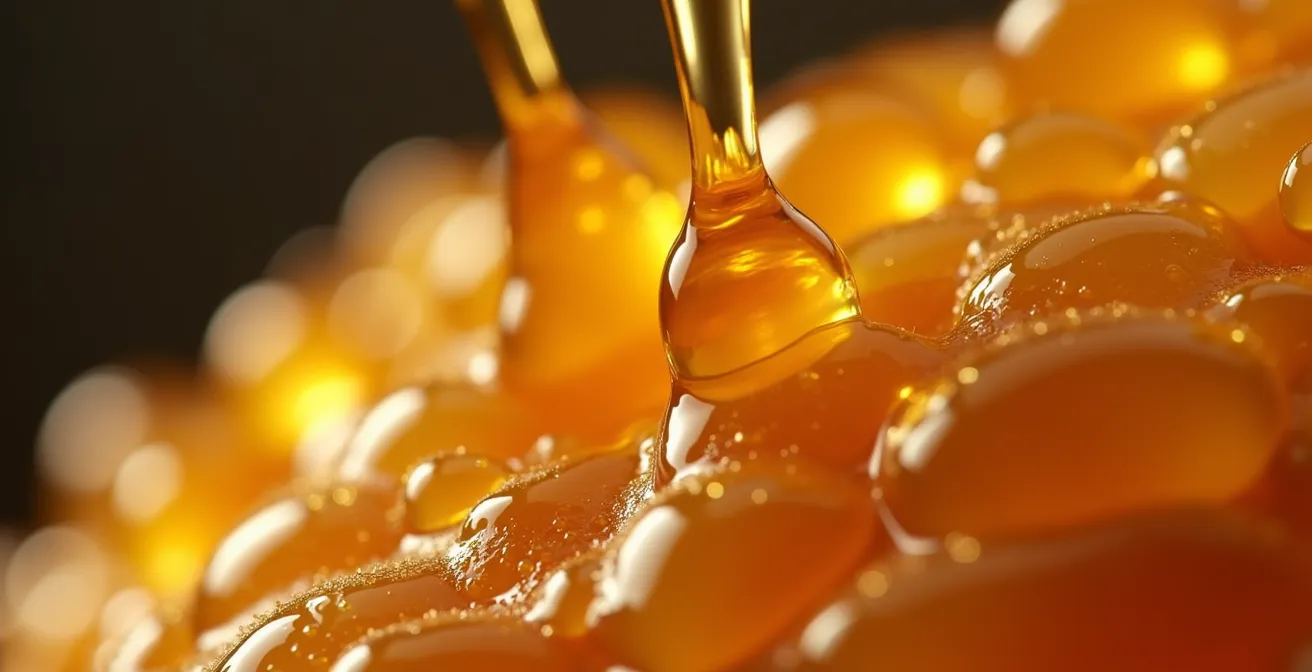
As shown in this representation, the viscous substance forms a protective and smooth layer. This coating effect is why users who find PG too aggressive turn overwhelmingly to majority-VG liquids. They aren’t just looking for bigger clouds, but a fundamentally different sensory experience, where texture takes precedence over raw impact.
Residual sugar: why does VG caramelize faster on your coils?
One of the main drawbacks of high-VG e-liquids is their tendency to clog coils faster. This effect, often described as “gunking,” is not a mystery but a simple chemical reaction: caramelization. Vegetable Glycerin, although used for its purity, retains a tiny amount of residual sugars from its manufacturing process (from vegetable oils like rapeseed or soy). Additionally, its taste is naturally slightly sweet.
When subjected to the intense and localized heat of the coil, these sugars reach their caramelization point. They break down and form a dark, hard carbon deposit that accumulates on the resistance wire and in the cotton. This deposit acts as an insulator, reducing heating efficiency and significantly altering the taste of your e-liquid. A “burnt” flavor or a decrease in vapor production are warning signs of a clogged coil.
This caramelization is much more pronounced with VG than with PG, which is chemically simpler and does not contain these residual sugars. Consequently, the higher the VG ratio of your liquid, the more frequent your coil replacements will be, which has a direct impact on the cost of using your electronic cigarette. Choosing a “Max VG” liquid is therefore a trade-off between dense, smooth vapor and more regular, costly maintenance.
| VG/PG Ratio | Average Lifespan | Estimated Monthly Cost |
|---|---|---|
| 30/70 (High PG) | 3-4 weeks | 15-20 CAD |
| 50/50 (Balanced) | 2-3 weeks | 20-30 CAD |
| 70/30 (High VG) | 1-2 weeks | 30-45 CAD |
| Max VG (90%+) | 5-10 days | 45-60 CAD |
The mistake of believing all atomizers accept “Full VG”
Thinking that a very high VG liquid (often called “Full VG” or “Max VG”) can be used in any type of electronic cigarette is a common mistake that leads to a very disappointing vaping experience, or even “dry hits” (dry puffs with a burnt taste). The main culprit is VG’s high viscosity. It is a thick, syrupy substance that flows much slower than PG, which is as fluid as water.
Atomizers designed for indirect inhalation (MTL, “Mouth To Lung”), like most pod systems and starter clearomizers, have very small juice ports. Their coils are designed to be saturated by a fluid e-liquid. When you try to use a Max VG liquid in them, the coil’s cotton cannot saturate quickly enough between two puffs. It dries out, and the coil heats the dry cotton instead of the liquid, producing that infamous burnt taste and prematurely damaging your equipment.
To vape a VG-rich e-liquid, it is therefore imperative to use suitable equipment: a so-called “sub-ohm” atomizer. These devices, whether clearomizers or rebuildable atomizers (RDA/RTA), are characterized by:
- Large juice inlets (“juice channels”) to allow thick liquid to pass through.
- Low-resistance coils (less than 0.5 ohm) capable of quickly heating a larger surface area.
- The need for a powerful box or mod, capable of providing the required energy (often more than 40 watts) to effectively vaporize this viscous liquid, which has greater thermal inertia.
Ignoring this match between liquid and hardware is the number one cause of bad experiences with High VG liquids.
USP/EP: how to certify that your VG is 99.9% pure?
When you inhale a product, the question of its purity is paramount. For Vegetable Glycerin used in e-liquids, this guarantee is provided by pharmaceutical-grade certifications. The two most recognized and reliable standards are USP (United States Pharmacopeia) and EP (European Pharmacopoeia). These acronyms are not simple marketing arguments; they certify that the VG was produced, tested, and purified according to extremely strict standards.
USP/EP grade VG guarantees a minimum purity of 99.5% to 99.9%, and above all, the absence of harmful contaminants like diethylene glycol or heavy metals. It ensures that the product is suitable for pharmaceutical or food use, which is the minimum required for a product intended to be vaporized and inhaled. In Canada, regulations are strict on this point. As one expert points out, manufacturers are subject to rigorous testing. On this subject, Clutch Vape specifies in its 2024 guide to Canadian vaping laws and regulations:
Manufacturers are subject to rigorous testing and certification processes to ensure their products meet established health and safety standards.
– Clutch Vape
Looking for the “VG USP” or “VG EP” mention on your e-liquid label or DIY (Do It Yourself) base is therefore an essential reflex. It is the assurance that you are using an ingredient whose quality and traceability are controlled, which is a fundamental safety guarantee. Being wary of low-priced liquids without a grade mention is a basic precaution for any health-conscious vaper.
Why is Vegetable Glycerin the engine of big clouds?
Vegetable Glycerin is unanimously recognized as the king ingredient for “cloud chasing.” This performance is not due to a single property, but to the synergy of three key physical factors. First, as we have seen, its hygroscopic nature allows it to capture air moisture, increasing the total volume of the aerosol. Second, its boiling point is higher than that of PG (290°C vs. 188°C). It requires more energy to be vaporized, but once transformed into vapor, it remains more stable and takes longer to dissipate, creating more persistent clouds.
Third, its molecule size is larger. VG vapor consists of larger and more numerous droplets, which increases the opacity and density of the cloud. The difference is striking when visually comparing the vapor from a 100% PG liquid and that of a 100% VG liquid.

This image perfectly illustrates the difference: on the left, a thin and discreet vapor typical of PG; on the right, thick, cotton-like plumes characteristic of VG. To exploit this potential to the maximum, it is not enough to choose a VG-rich liquid. One must create optimal conditions for its vaporization, which involves precise adjustment of the hardware.
Your action plan for dense and velvety vapor
- Liquid Choice: Opt for an e-liquid containing at least 70% Vegetable Glycerin (VG) to ensure a base conducive to dense vapor.
- Coil Selection: Use a “sub-ohm” type coil (value less than 1 ohm, ideally between 0.15 and 0.4 ohm) to reach the 290°C temperature necessary for effective VG vaporization.
- Power Setting: Adapt the power of your box mod according to your coil, generally in a range of 40 to 80 watts, to provide the required energy.
- Airflow Management: Fully open the airflow inlets of your atomizer to allow for a direct and airy draw (DL – Direct Lung), essential for producing large volumes of vapor.
- Hydration: Drink water regularly throughout the day to counter the dehydration effect caused by the hygroscopic nature of VG.
Droplets on the box: how cold air condenses external vapor?
Canadian vapers are well-acquainted with this winter phenomenon: fine droplets of liquid appearing on the electronic cigarette and around the mouthpiece (drip tip) when vaping in cold weather. This is not an atomizer leak, but a process of accelerated condensation. The vapor you exhale is a warm aerosol saturated with moisture, notably due to VG’s hygroscopic properties.
When this warm vapor comes into contact with the outside air, where the temperature is very low, it quickly reaches its “dew point.” This is the temperature at which the water vapor contained in the air (and in your vape cloud) can no longer remain in a gaseous state and turns back into liquid. The colder and more humid the air, the faster and more pronounced this phenomenon is. The vapor condenses instantly upon contact with cold surfaces, including your equipment, forming these famous droplets.
This table illustrates how the dew point is affected by temperature and humidity, explaining why condensation is so frequent during a winter in Quebec or Winnipeg.
| Outside Temperature | Relative Humidity | Dew Point | Immediate Condensation |
|---|---|---|---|
| -20°C | 60% | -25°C | Yes |
| -10°C | 70% | -14°C | Yes |
| 0°C | 80% | -3°C | Moderate |
| 10°C | 85% | 8°C | Low |
This phenomenon is generally not problematic, but it is good to regularly wipe your equipment to prevent liquid from seeping into the connectors or the box buttons. It is simply a visible manifestation of fluid physics in extreme conditions, amplified by VG’s ability to create water-rich vapor.
Key Points to Remember
- Vegetable Glycerin (VG) is not a simple ingredient, but a texturizing agent that physically modifies vapor through its hygroscopic properties.
- The perceived smoothness in the throat comes from VG’s ability to form a protective molecular film, coating the nicotine and masking its irritation.
- Exploiting VG’s potential requires suitable equipment (sub-ohm atomizer, high power) due to its high viscosity and thermal inertia.
How to switch to “airy” vaping without choking or overdosing?
Adopting “airy” vaping or direct lung (DL) inhalation, typical of high-VG e-liquids, is a transition that requires a few adjustments to be enjoyable. The goal is no longer just to satisfy a nicotine need, but to seek a sensory experience. In fact, according to the Canadian Tobacco and Nicotine Survey, 27% of 20-24 year olds vape simply because they enjoy it, which highlights the importance of the pleasure dimension.
The first reflex must be to drastically decrease your nicotine level. A sub-ohm atomizer vaporizes a much larger volume of liquid with each puff than an MTL system. If you keep the same nicotine level (for example, 12 mg/mL), you will absorb a much too high dose, causing coughing, dizziness, and headaches. For DL vaping, recommended levels are generally between 0 and 6 mg/mL, with 3 mg/mL being the most common standard.
Next, you must relearn how to inhale. Unlike MTL vaping where you draw into the mouth and then into the lungs (like a classic cigarette), DL vaping consists of drawing the vapor directly and deeply into the lungs, as if taking a deep breath. This requires a longer, smoother puff and a wide-open airflow. Attempting a direct inhalation with a restricted airflow will almost certainly cause coughing, as the vapor will be too hot and too dense. The key is to let the air mix abundantly with the vapor to cool and thin it.
By mastering these adjustments—reducing nicotine and using the direct inhalation technique with an open airflow—you will transform your vaping experience. You will move from simple substitution to an exploration of flavors and textures, where each puff becomes a moment of controlled pleasure rather than a necessity.
Frequently asked questions about how VG transforms your vapor texture into velvet?
Can I use 100% VG in my pod system?
No, it is not recommended. Most pod systems are designed for thinner liquids (50/50 or higher PG). Vegetable glycerin, being very thick, cannot properly saturate the small coils in these systems, leading to a burnt taste (“dry hit”) and damaging the hardware.
What is the viscosity of VG at -20°C?
At a temperature of -20°C, typical of the Canadian winter, vegetable glycerin becomes extremely viscous, to the point of approaching a solid state. Its use in most atomizers becomes practically impossible, as the liquid can no longer flow to feed the coil.
How do I adapt my equipment for Full VG?
To use a “Full VG” e-liquid (very rich in vegetable glycerin), you must use a sub-ohm type atomizer (rebuildable or clearomizer) with large juice ports. Pair it with coils having a value lower than 0.5 ohm and a box capable of providing at least 40 watts of power to effectively vaporize this thick liquid.