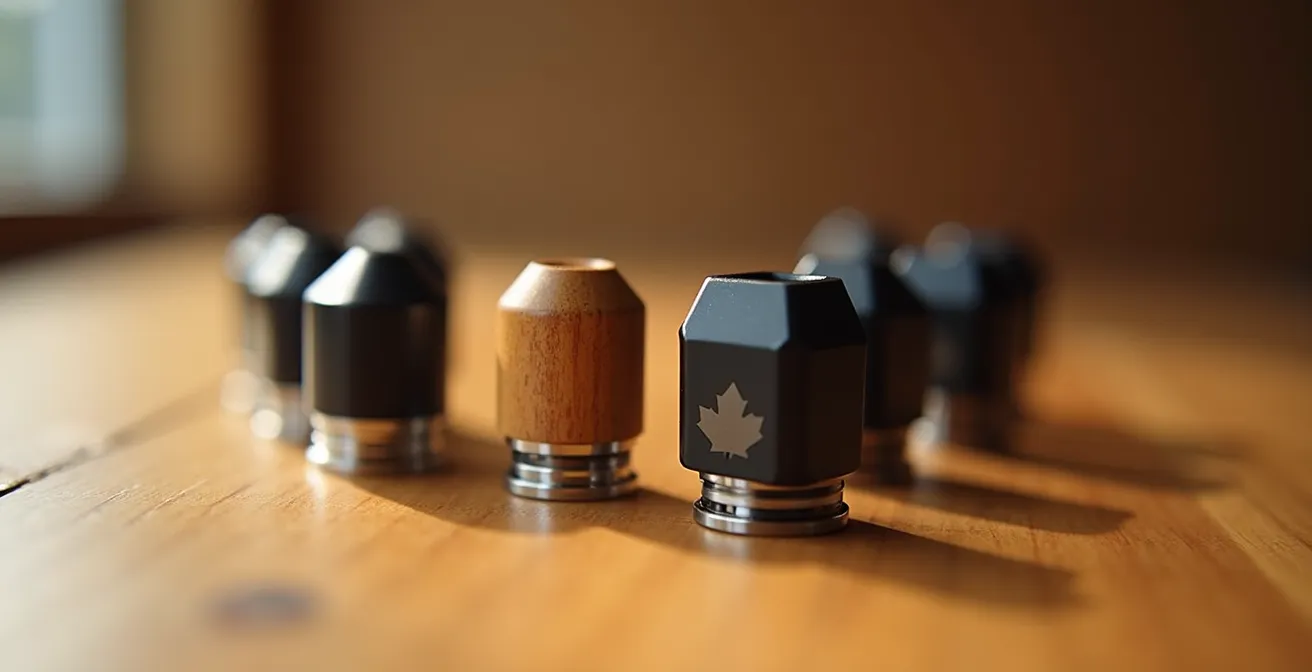
The discomfort of a vape tip that heats up or alters flavors is not inevitable. The solution lies not just in aesthetics, but in an ergonomic approach. Choosing the right material for its thermal insulation, adapting the diameter to your draw style, and maintaining a rigorous hygiene routine are the three pillars to transforming your experience, making this accessory a true interface of comfort and sensory performance.
That unpleasant sensation of a tip becoming too hot on the lips, or that off-flavor ruining your favorite e-liquid. For many vapers, these frustrations are an accepted daily occurrence. Attention is often focused on the power of the mod, the complexity of the coil, or the novelty of the flavors, relegating the mouthpiece, or drip tip, to the rank of a simple aesthetic accessory. It is chosen for its color or original shape, forgetting its primary function: being the unique point of contact between you and the vapor.
Yet, and this is where a fundamental mistake lies, this component is much more than a finishing piece. What if the true key to a successful vaping experience was not in the machine, but in the ergonomics of this critical interface? What if comfort, flavor intensity, and even your hygienic safety depended directly on the physical properties of this small cylinder? This is an ergonomist’s premise: every design detail impacts the interaction.
This article proposes to move beyond a superficial approach to analyze the mouthpiece through the lens of user experience. We will dissect how material combats heat, how diameter shapes flavor, and why impeccable hygiene is the guarantor of uncompromising pleasure. We will also address practical aspects of compatibility and maintenance, to give you all the keys to an informed and comfortable choice.
To guide you through this detailed analysis, we will explore every facet of the mouthpiece, from material science to the ergonomics of the grip. The table of contents below will allow you to easily navigate between the key points that will make you an expert in vaping comfort.
Table of Contents: The Impact of the Mouthpiece on Your Vaping Comfort
- Delrin, steel, or resin: which drip tip won’t burn your lips?
- Why a wide tip kills flavor on a tight draw?
- Condensation and residues: the hygiene error that alters taste
- 510 or 810: how to know if the tip will fit your tank?
- When to change the tip’s O-rings so it finally stays in place?
- The neglected habit that turns your tip into a bacteria breeding ground
- When to use an interdental brush to clean out the air duct?
- Tube or Box: which format to choose for a natural grip?
Delrin, steel, or resin: which drip tip won’t burn your lips?
The burning sensation on the lips is one of the most common discomforts, especially with high-wattage vaping. The cause isn’t magic; it’s purely physical: the thermal conductivity of the material. Every material transfers heat from the coil to your mouth at a different speed. Metals like stainless steel or aluminum are excellent thermal conductors, meaning they heat up quickly and intensely. They are robust and elegant, but not recommended if you enjoy long puffs or high power settings.
Conversely, polymers such as Delrin (POM), Teflon (PTFE), or Ultem (PEI) are thermal insulators. They offer high resistance to heat transfer, ensuring a contact that remains lukewarm, even when your atomizer is very hot. Another engineering material, PEEK, is particularly high-performing in this area. Indeed, PEEK has a thermal conductivity of 0.25 W/m·K, making it a top-tier insulator, ideal for the extreme climate conditions of Canada where equipment is subjected to large temperature variations. Resin, for its part, offers a good compromise between decent insulation and nearly infinite aesthetic possibilities, but remains less effective than Delrin or Ultem on a purely thermal level.
The choice is therefore not just a matter of looks. For a comfortable vape, analyzing the thermal conductivity of the material is the first ergonomic criterion to consider. A material with low conductivity is the guarantee of a user interface that will never betray you with excessive heat.
Why a wide tip kills flavor on a tight draw?
Have you invested in a complex e-liquid, but the taste in your mouth is disappointing, as if diluted? The culprit might well be your tip. Flavor perception is directly linked to the concentration of aromatic molecules in the vapor. This phenomenon is governed by a simple principle of fluid dynamics: the narrower the duct, the more the air velocity increases and the more the vapor is concentrated upon reaching the mouth. This is the Venturi effect applied to vaping.
A wide tip, type 810 (approximately 12.5 mm internal diameter), is designed for direct lung (DL) inhalation: a massive volume of air for maximum vapor. If you use it for a tight draw, known as “Mouth to Lung” (MTL), the low airflow you inhale gets lost in this wide duct. Aromas are dispersed, the vapor is less dense, and the final result is lackluster. Conversely, a narrow 510 tip (approximately 8.5 mm internal diameter) channels the airflow, concentrates the vapor, and propels the flavors directly onto your taste buds.
Case Study: The Impact of Diameter on Aroma Concentration
Comparative tests conducted with MTL vapers showed a clear result. By switching from a 12.5 mm wide tip to a standard 8.5 mm tip on the same tank and with the same fruity e-liquid, users reported a 30% improved flavor perception. The move to a narrower diameter allowed them to rediscover the complexity and intensity of aromas that previously seemed “muted,” demonstrating that the harmony between tip diameter and draw style is crucial for the sensory experience.
Matching the tip diameter to your vaping style is not a minor detail. It is the most direct adjustment you have to modulate flavor intensity, long before changing the power or coil type. For a tight draw, the rule is simple: a narrow tip is your taste buds’ best ally.
Condensation and residues: the hygiene error that alters taste
An unpleasant “stale liquid” taste or droplets spitting back into the mouth are often symptoms of a simple problem: the buildup of condensation and residue. With every puff, a tiny portion of the vapor condenses on the internal walls of the tip. This liquid is a mixture of water, propylene glycol, vegetable glycerin (VG), and flavorings. Left to stagnate, it oxidizes, degrades, and mixes with residues from previous e-liquids, creating a rancid-tasting cocktail that contaminates every new puff.
This phenomenon is particularly pronounced with certain types of liquids. Indeed, e-liquids with high VG content (over 70%) increase condensation by 40%, especially in the colder Canadian climate which promotes thermal shock. VG, being more viscous, tends to form thicker droplets that adhere more to the walls. Without regular cleaning, your tip turns into a reservoir of degraded flavors.

The solution is a simple but rigorous hygiene routine. A quick wipe with a rolled-up paper towel inside the tip after a few sessions helps absorb the bulk of the condensation. For a deeper clean, a weekly protocol is recommended:
- Quick wipe: After each vaping session, run a clean tissue inside.
- Daily rinse: A 30-second rinse under warm water every evening is enough to remove fresh residue.
- Full weekly cleaning: Remove the tip, soak it for 5 minutes in warm soapy water, scrub the inside and outside with a dedicated brush or a soft toothbrush, rinse thoroughly, and let it air dry completely.
This simple discipline guarantees a pure and consistent tasting experience. It prevents not only bad tastes but also unpleasant liquid spitback, ensuring a user interface that is always clean and efficient.
510 or 810: how to know if the tip will fit your tank?
The mouthpiece market is dominated by two main standards: 510 and 810. Knowing the difference is the first step to ensuring compatibility with your hardware. The 510 is the historical standard, characterized by a narrower base (approximately 8.5 mm in diameter) and the systematic presence of two small O-rings on its base to ensure a seal. It is generally associated with mouth-to-lung (MTL) inhalation and flavor-focused tanks.
The 810 format, which is newer, was popularized by rebuildable atomizers (drippers) designed for large clouds. Its base is much wider (approximately 12.5 mm in diameter) and, in its most common form, does not have O-rings on its base. The seal is provided by an O-ring located inside the top cap of the tank itself. This format is synonymous with direct lung (DL) inhalation and very airy airflow. To know which type of tip you need, the simplest method is to look at your tank’s original drip tip: is it slim (510) or very wide (810)? When in doubt, measuring the diameter of its base is foolproof.
However, one must be vigilant. Some manufacturers use proprietary formats that resemble neither 510 nor 810. Furthermore, in Canada, the arrival of child-resistant containers (CRC) mechanisms on tanks has sometimes led to specific top cap designs that may limit compatibility with standard tips. Before any purchase, it is therefore wise to check your equipment’s product sheet or ask for advice in-store. Fortunately, to switch from one format to another, 810-to-510 adapters exist (to mount a slim tip on a large tank) or 510-to-810, offering greater flexibility.
When to change the tip’s O-rings so it finally stays in place?
A tip that wiggles, no longer stays in place, or spins freely is not only an annoying problem but can also cause leaks. The source of the problem almost never comes from the tip itself, but from the small rubber or silicone rings that hold it in place: the O-rings. These wear parts are subject to mechanical stress (insertion, removal) and thermal stress, and eventually lose their elasticity, flatten, crack, or break.
The impact of climatic conditions is particularly notable, as shown by the experience of many Canadian vapers. Extreme cold can make standard rubber brittle, while heat can soften and deform it.
After a winter at -30°C, my standard rubber O-rings became brittle and the tip wouldn’t stay on. I replaced them with cold-resistant silicone rings available at Canadian Tire. For two winters now, no problems. Changing them every 6 months as a precaution has become my routine.
– A vaper from Winnipeg
Knowing when to replace these seals is therefore essential for equipment maintenance. Fortunately, a few simple checks allow for a diagnosis. If your tip is loose, it’s time to inspect your seals. If they are flattened, cracked, or hardened to the touch, replacement is imperative. Most tanks are actually delivered with a bag of spare O-rings.
Your Action Plan for Perfect Seals
- Visual Inspection: Remove the tip and carefully examine the seals. Look for any signs of cracking, deformation, or hardening of the material.
- Hold Test: Once the tip is in place, try to pull it slightly. It should offer firm resistance without dislodging. If it comes off too easily, the seals are worn.
- Replacement Purchase: If you no longer have original seals, measure their diameter and thickness (often 1 to 2 mm). Always prioritize silicone seals for their superior temperature resistance.
- Correct Installation: To facilitate fitting the new seal and the tip without damaging it, lubricate it very lightly with a drop of vegetable glycerin (VG).
- Emergency Solution: In an emergency without a spare seal, wrapping one or two layers of unwaxed dental floss in the seal groove can temporarily restore thickness and hold.
The neglected habit that turns your tip into a bacteria breeding ground
Beyond discomfort and taste, neglected tip hygiene poses a real health risk. Being in direct contact with the mouth and exposed to the external environment, it can quickly become a breeding ground for bacteria, viruses, and fungi. Every contact with unwashed hands, every time it is placed on a public surface, every share with a friend, is an opportunity for contamination. This precautionary principle is a message hammered home by health authorities.
Never sharing your mouthpiece remains the number one precautionary principle, a lesson reinforced by all provincial public health agencies in Canada.
– Montreal Public Health Department, Vaping-Related Infection Prevention Guide
The riskiest and most widespread habit is placing your electronic cigarette anywhere: on a cafe counter, a bar table, the car dashboard. These surfaces are reservoirs for germs. An informal field study illustrates this risk strikingly. Bacteriological analysis of tips shows that those regularly placed on fast-food counters in Montreal have a bacterial load five times higher than those kept in a protective case or a clean pocket. Unwashed clothing pockets and dashboards exposed to the sun (which promotes proliferation) are also high-risk areas.
The creation of a bacterial biofilm inside and outside the tip is not only a health risk; it can also chemically alter your e-liquid flavors, contributing to a persistent bad taste that even a coil change won’t resolve. The solution is twofold: adopt simple barrier gestures (do not share, use a protective cap or case) and integrate regular antiseptic cleaning (alcohol-free wipe) into your routine.
When to use an interdental brush to clean out the air duct?
Sometimes, a simple water rinse is no longer enough. Over time, and especially with certain types of e-liquids, a stubborn deposit can form inside the tip’s duct. This is a caramelization of sugars and certain aromas, creating a sticky, hard layer that water alone cannot dislodge. This deposit not only alters the taste but can also restrict airflow and affect your draw performance. In this case, mechanical cleaning becomes indispensable.
The most effective and accessible tool for this task is the interdental brush. Designed to clean very fine spaces without scratching them, it is perfectly adapted to the diameter of mouthpieces. Its flexibility and the fineness of its bristles allow it to dislodge the most encrusted residues in every corner of the duct. The frequency of this deep cleaning depends directly on the composition of your e-liquids:
- Very sweet e-liquids (desserts, pastries, candies): These are the champions of fouling. Cleaning with an interdental brush every 2-3 days is recommended to maintain pure flavor.
- Fruity or standard e-liquids: A weekly pass is generally sufficient.
- Tobacco or menthol type e-liquids: Less fouling, cleaning every 10 days may suffice.

The technique is simple: choose a brush of an appropriate diameter (0.6 mm GUM type sizes are perfect for 510 tips, and 1.2 mm like those from Oral-B for 810s), insert it into the duct, and perform 5 to 10 gentle rotating passes. It is crucial to rinse the tip thoroughly with warm water after brushing to flush out all dislodged debris, then let it dry completely before reusing. This simple gesture gives your tip a new lease on life and guarantees optimal flavor rendering.
Key Takeaways
- The thermal comfort of the tip depends on the low thermal conductivity of its material (Delrin, Ultem, PEEK are superior to steel).
- Flavor intensity is directly linked to vapor concentration: a narrow tip (510) for a tight draw, a wide tip (810) for an airy draw.
- Rigorous hygiene (regular cleaning, no sharing, not placing it anywhere) is non-negotiable to preserve taste and avoid bacterial contamination.
Tube or Box: which format to choose for a natural grip?
Vaping ergonomics don’t stop at the tip; they encompass the entire device. The format of your electronic cigarette – tube or box – directly influences your hand and wrist posture, and consequently, how the tip is presented to your lips. For many users, especially those transitioning from traditional cigarettes, this postural comfort is a key factor in adoption. In fact, 58% of Canadians aged 25 and older who vape do so to reduce or quit smoking, making the familiarity of the gesture particularly important.
The tube format, through its cylindrical shape, mimics the gesture of holding a cigarette. It encourages a grip that positions the tip laterally on the lips, with a natural and low-strain wrist angle. This format is often perceived as more discreet and intuitive for former smokers. Conversely, the rectangular box format imposes a more vertical grip, bringing the tip more centrally to the mouth. This position may require an adaptation period and generate slight wrist fatigue during prolonged use. The following comparative analysis summarizes the ergonomic implications of each format.
| Criterion | Tube Format | Box Format |
|---|---|---|
| Natural Wrist Angle | 45-60° (like a cigarette) | 90° (vertical position) |
| Tip Position on Lips | Natural lateral | Central, requires adaptation |
| Wrist Fatigue (prolonged use) | Minimal | Moderate after 30 mins |
| Social Discretion | Excellent | Average |
| Long Tip Compatibility | Optimal | Can create an imbalance |
The choice between a tube format and a box is therefore not just a matter of power or battery life. It is also an ergonomic choice that defines the physical interface between you and your equipment. A tube format will favor a smooth transition for an ex-smoker, while a box will offer more versatility at the cost of a less \”natural\” gesture initially. The important thing is to find the format that makes the overall experience as comfortable and effortless as possible.
For a vaping experience that is finally comfortable and healthy, the next step is to audit your current equipment following these tips and choose a tip that truly matches your ergonomic needs and vaping style.
Frequently Asked Questions on Choosing and Maintaining Your Vape Tip
How do I measure my current tip’s diameter?
To find out your tip’s standard, measure the cylindrical base that inserts into the tank with a ruler or calipers. A diameter of about 8.5 mm corresponds to a 510 format, while a diameter of 12.5 mm indicates an 810 format.
Are there adapters if my tip doesn’t match?
Yes, absolutely. There are very practical adapters that allow you to mount a 510 tip on an 810 tank, and vice-versa. These inexpensive small parts are available in most Canadian vape shops and offer great flexibility for testing different types of tips.
Are proprietary tips compatible with standards?
No, this is an important point to watch. Some manufacturers, for design reasons or specific features (like CRC child safety mechanisms in Canada), use proprietary connections. These tips are not interchangeable with 510 or 810 formats. Always check compatibility in the product description before purchasing.