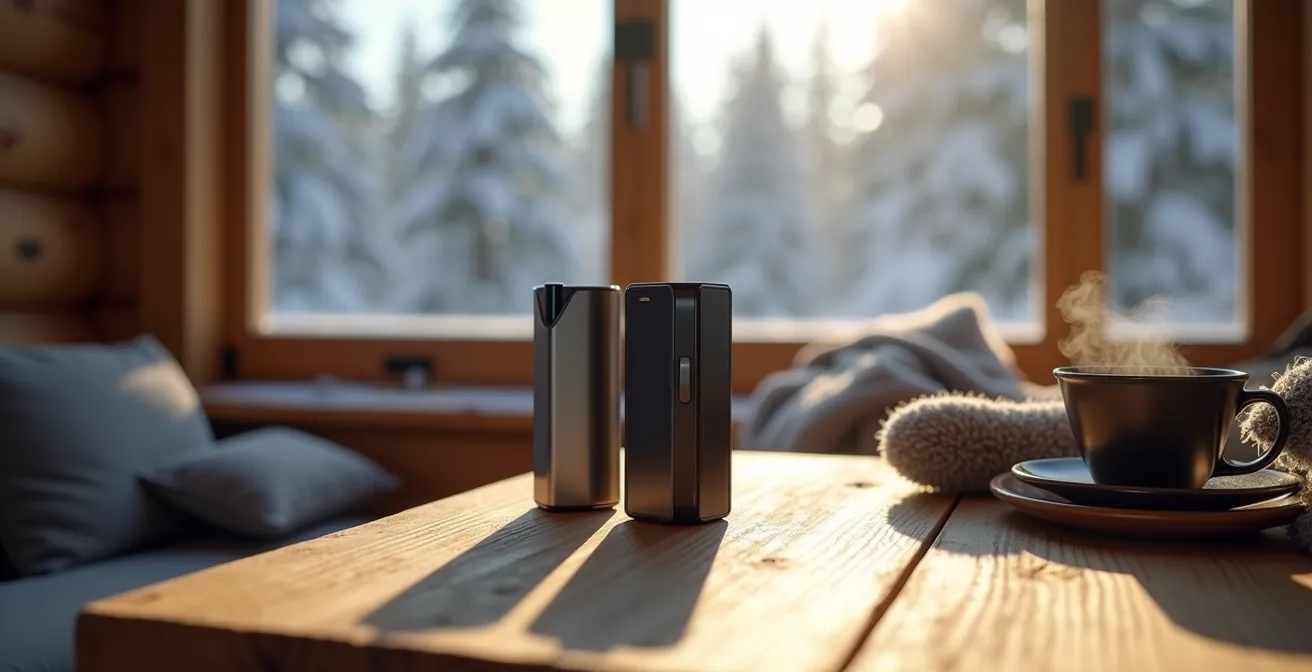
The tube format is not a relic of the past, but a deliberate design choice prioritizing robustness and contextual ergonomics, particularly suited to Canadian conditions.
- The cylindrical shape offers superior structural resilience to pressure in a pocket and better thermal insulation in cold weather.
- Minimalist interaction (one button, auto-draw) proves more effective than complex screens when wearing winter gloves.
Recommendation: For mobile use, where size, simplicity, and resistance to the elements are paramount, the modern tube format often surpasses the box mod in terms of pure ergonomic efficiency.
Choosing an electronic cigarette often boils down to a technical debate: power, battery life, and adjustment options. We often contrast the “box,” perceived as a tool for control-hungry experts, with the “tube,” relegated to the status of a simple entry point for beginners. This view is not only reductive but ignores the essential: the physical relationship between the user and the object. As an industrial designer, my approach focuses on ergonomics, grip, and how the shape of an object influences its daily use. Pocket bulk, the feel in the hand, or ease of use with gloves are not details—they are the heart of the user experience.
But what if the true key wasn’t the spec sheet, but rather how well the design fits a real-world context of use? This is particularly true in Canada, where climatic constraints and an active lifestyle redefine priorities. The “tube vs box” debate is no longer a question of power, but of design philosophy. On one side, the modular versatility of the box. On the other, the robust simplicity and targeted efficiency of the tube. This article proposes to look beyond a simple comparison of features to analyze these two formats through the lens of industrial design and contextual ergonomics, helping you choose not the most powerful device, but the one best suited to your hand and your life.
To make an informed choice, it is essential to analyze in detail how each shape meets daily challenges. This guide breaks down the crucial aspects of ergonomics, durability, and practicality for each format, testing them against the realities of mobile use.
Summary: The Ergonomic Duel Between Tube and Box Formats
- Why does the cylindrical shape resist pocket pressure better?
- The mistake of thinking you can’t adjust anything with a single button
- 3000mAh Tube vs Pod: Which offers the best size-to-autonomy ratio?
- How to effectively lock a flush switch to avoid accidental firing?
- When to clean the 510 connection to avoid Volt Drop?
- Built-in battery or external cells: What to choose for 14 hours without a plug?
- Matte black or steel: Which finish resists pocket keys best?
- How to deep clean your tank to switch from mint to tobacco?
Why does the cylindrical shape resist pocket pressure better?
In industrial design, the choice of a shape is never accidental. The superiority of the cylinder against pressure is a fundamental physical principle. Unlike a rectangular box with flat faces and edges, a tube distributes forces uniformly across its entire surface. When a tube is compressed in a tight jean pocket or at the bottom of a backpack, the pressure is distributed without a concentrated weak point. A box, with its 90-degree angles, undergoes maximum stress on its corners and faces, increasing the risk of deformation, screen cracks, or panel separation. This is called structural resilience.
This inherent robustness is heightened in a Canadian context. Practical experience in winter conditions shows that shape also has a thermal impact. The tube format, being more compact, retains body heat better when placed in an inner parka pocket. This natural insulation helps preserve battery life, which tends to drop drastically in extreme cold. The cylindrical shape is therefore not just an aesthetic heritage, but a pragmatic design choice that promotes durability and reliability in demanding conditions. The object becomes a robust extension of the hand, designed to endure daily life without failing.
The mistake of thinking you can’t adjust anything with a single button
Minimalism in design is often misinterpreted. The presence of a single button on a tube is not a limitation, but the result of a reflection on minimalist interaction. The premise is simple: 90% of users, once they find their comfort setting, no longer touch it. Complex screens, menus, and multiple buttons on boxes, while offering great versatility, introduce unnecessary cognitive load for daily use. Modern tube design starts from the principle that the best interface is the one that fades away.
The single button, often called the “switch” or “fire button,” becomes the unique point of contact, optimized for tactile feedback and simplicity. Its primary function is activation, but it also serves, through a series of predefined clicks (usually 3 or 5), to lock the device or sometimes change power modes. It is a simple interaction grammar, learned in seconds and executed without even looking at the object.
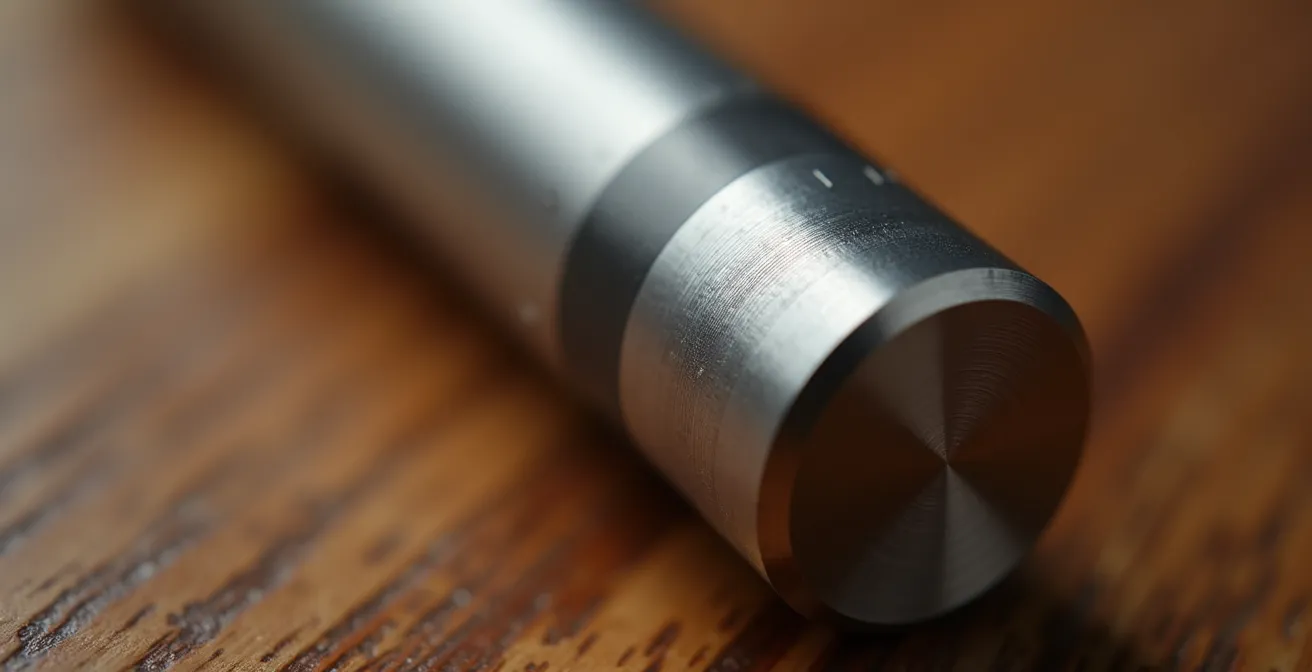
This approach is a form of functional elegance. It eliminates potential failure points (cracked screens, clogged additional buttons) and concentrates manufacturing quality on a single essential component. Rather than offering an infinite number of rarely used settings, the tube offers an optimized, frictionless experience where technology is forgotten in favor of the act itself. It’s not fewer features; it’s the right features, perfectly executed.
3000mAh Tube vs Pod: Which offers the best size-to-autonomy ratio?
Raw battery life, expressed in milliampere-hours (mAh), is only part of the equation. The true performance indicator for a mobile device is the form-to-autonomy ratio: how much energy do you get for a given size? This is where the tube format shines compared to pods, which are often praised for their compactness. A modern tube can integrate a 3000mAh battery within a diameter of about 25mm, offering remarkable energy density.
Let’s take a concrete example. A 3000mAh tube, running at 4V with a 0.6-ohm coil, allows for about 27 minutes of continuous use. For a user taking regular breaks, this translates to a full workday, or about 9 to 10 hours of real-world battery life. In comparison, a 1500mAh pod, although optimized for low-power vaping (MTL), will offer similar duration but is often limited by its smaller capacity, especially if high nicotine concentration e-liquids (limited to 20mg/mL in Canada) are not used.
However, this calculation must be weighted by the Canadian climate factor. Winter condition tests are clear, confirming a 30 to 50% loss of autonomy at -20°C for all lithium-ion batteries. Starting with a higher initial capacity, like that of a 3000mAh tube, provides a crucial safety margin. Even when reduced by a third, the battery life remains sufficient to get through the day, whereas a smaller pod might require a mid-afternoon recharge.
How to effectively lock a flush switch to avoid accidental firing?
Accidental firing in a pocket is one of the major concerns for mobile device users. Manufacturers have standardized a simple and effective solution: multi-click locking. On almost all models, whether tubes or boxes, activation and deactivation are done by 5 quick, successive presses on the switch. This sequence, too complex to be performed by accident, transforms a simple action into a reliable security code.
However, the ergonomics of this function are put to the test by the Canadian climate. A practical evaluation demonstrated the difficulty of this manipulation with thick winter gloves. The lack of tactile feedback and precision leads to a high failure rate, making locking and unlocking frustrating. This is a perfect example of contextual ergonomics, where a viable solution in a temperate environment becomes problematic at -20°C.
Faced with this challenge, a design innovation stands out: “auto-draw” or inhalation triggering. More and more modern tubes integrate this technology, which completely eliminates the need to press a button to activate the device. A pressure sensor detects inhalation and activates the system automatically. The physical switch, if present, is then only used to turn the device on/off or lock it—actions usually performed with bare hands. This dissociation of functions offers an ideal solution for winter conditions, ensuring flawless use even with mittens, while preventing any risk of accidental firing.
When to clean the 510 connection to avoid Volt Drop?
The 510 connection is the nerve center of your device: it is the standardized contact point between the battery (the tube) and the atomizer (the tank). A clean connection ensures optimal current transfer. Over time, micro-residues of liquid or dust can accumulate on the threads and the contact pin. This grime creates parasitic resistance that causes “voltage drop” or Volt Drop. In practical terms, the power reaching your coil is lower than what the battery provides, resulting in less dense vapor production and altered flavors.
Regular maintenance is therefore essential, particularly with sweet e-liquids, which are very popular in Canada and tend to caramelize slightly. Ignoring this cleaning is one of the main causes of degraded performance that users wrongly blame on their hardware. A simple protocol maintains a perfect connection. Since condensation is more frequent in winter due to thermal shocks between indoors and outdoors, more regular cleaning is recommended during this period.
Your action plan for perfect 510 connection maintenance:
- Frequency: Plan a cleaning every 3 refills if you use sweet flavors (maple, red fruits, etc.).
- Materials: Use a simple cotton swab and 70% isopropyl alcohol, easily found in pharmacies (at Jean Coutu or Pharmaprix, for example).
- Quick Diagnosis: Perform the “cotton swab test.” Run a dry swab through the threads. If it comes out yellow or brown, cleaning is necessary.
- Cleaning: Lightly soak the swab in alcohol and clean the threads and the connection pin of the tube by turning it 3 times in each direction. Do the same with the base of your tank.
- Drying: Let it air dry for at least 30 seconds before screwing the tank back on to avoid any risk of short-circuit.
Battery integrated or cells: What to choose for 14 hours without a plug?
For a mobile user, especially a worker who spends long days away from a power outlet, the question of power source is crucial. The choice lies between two philosophies: the built-in battery, which prioritizes simplicity, and the removable cell system (such as 18650 or 21700 formats), which focuses on flexibility. The built-in battery, soldered into the tube, recharges via a USB port. It is simple and direct, but when the battery reaches the end of its life (usually after 300 to 500 charge cycles), the entire device must be replaced.
The removable cell system dissociates the device from its energy source. It allows you to carry several pre-charged batteries and swap them in seconds, offering virtually unlimited battery life. For a Canadian construction worker, a cost-benefit analysis shows that the initial investment quickly pays off. As noted in analysis for heavy vapers, the ability to replace only the batteries can lead to long-term savings, as it avoids purchasing a complete new device every 12 to 18 months. Investing in a good external charger (35-50 CAD) and a few pairs of quality cells (40-60 CAD) is more sustainable and economical over time.
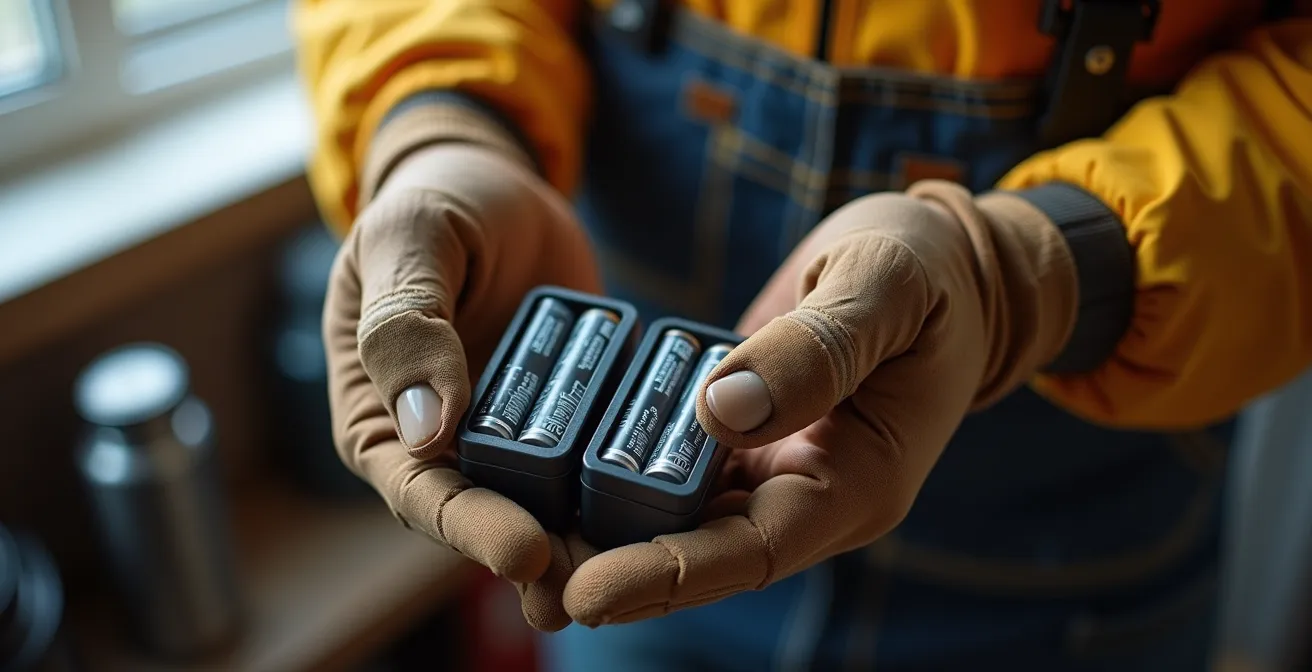
This flexibility is the key to lasting a 14-hour day without stress. By leaving in the morning with one cell in the device and one or two more in reserve (always carried in an insulating protective case), you free yourself from dependence on a power source. It is a more demanding approach in terms of management, but it offers unparalleled freedom and energy resilience, perfectly suited for professional and intensive use.
Matte black or steel: Which finish resists pocket keys best?
The durability of an object is also measured by its ability to age well. The choice of coating has a direct impact on how your device looks after several months of use. The ultimate test is the pocket, where the tube coexists with keys and coins. A practical test, simulating contact with typically Canadian objects like car keys and coins (Loonie and Toonie), reveals notable differences between finishes.
The clear winner in terms of pure resistance is brushed stainless steel. Its texture very effectively hides the inevitable micro-scratches of daily life. After several months, the general appearance remains clean and consistent. Conversely, matte black coatings, although very pleasant to the touch (soft-touch), are more fragile. Contact points with hard objects quickly leave shiny marks or chips, revealing the underlying metal. The initial “stealth” aesthetic quickly degrades into a worn look, sometimes perceived as a patina, but often just as simple wear and tear.
However, the performance of a material must also be evaluated in context. At -10°C, stainless steel becomes freezing to the touch—a particularly unpleasant contact. Matte black or rubberized finishes offer better thermal comfort. The choice is therefore a compromise, as is often the case in design. Here is a quick guide to help you:
- Brushed Steel: Ideal for intensive use and maximum durability of appearance. Recommended if you carry your device “loose.” Cold feel in winter.
- Matte Black (soft-touch): Very comfortable to the touch, even in extreme cold. Marks quickly and requires more care.
- Rubberized Coating: Excellent grip, even with gloves, and good shock resistance. May tend to peel at the edges over time.
- Anodized Aluminum: A good compromise between lightness and scratch resistance. Less cold to the touch than steel.
Key Takeaways
- The tube format, by its cylindrical nature, offers better pressure resistance in a pocket and more effective thermal insulation in cold weather.
- Ergonomics in Canadian winter conditions (gloves, cold) favor simple designs like single-button tubes or auto-draw systems.
- The choice between integrated batteries and removable cells is strategic: one offers simplicity, the other unlimited battery life and long-term savings for heavy users.
How to deep clean your tank to switch from mint to tobacco?
One of the pleasures of electronic cigarettes is being able to vary flavors. However, some aromas, like mint, coffee, or certain very powerful fruits, are particularly stubborn. They soak into the seals and the tank, creating a “ghost flavor” that pollutes the next flavor. Switching from an icy mint to a classic tobacco without deep cleaning is often a disappointing experience. Fortunately, a simple procedure using everyday products can restore your tank to like-new condition.
The full cleaning protocol, to be performed with every coil change or flavor family swap, ensures optimal flavor purity. Here are the steps to follow, using products easily accessible in Canada:
- Disassembly: Completely disassemble your tank, taking care to remove all silicone O-rings.
- Basic Soak: Submerge all parts (except the coil) for 30 minutes in a solution of lukewarm water (250ml) and two tablespoons of white vinegar (a brand like Loblaws’ No Name works perfectly).
- Intensive Soak: For very stubborn flavors like mint or maple-coffee, add a tablespoon of baking soda (like Arm & Hammer) to the soaking solution.
- Brushing: Use a small dedicated toothbrush to gently scrub all parts, focusing on the threads and crevices.
- Rinsing: Rinse each component thoroughly with clean water to remove all traces of vinegar or baking soda.
- Drying: Let the parts air dry completely for at least two hours or use a hair dryer on the cold setting to speed up the process.
For those in a hurry, it is possible to opt for a multi-tank strategy. Owning a tank dedicated to each major flavor family (fruity, dessert/gourmet, tobacco) is the most convenient solution, though more expensive initially. A recent comparative analysis helps visualize the cost-benefit trade-off of each approach.
| Strategy | Initial Cost (CAD) | Advantages | Disadvantages |
|---|---|---|---|
| Single tank + cleaning | 0 | Economical | Time-consuming, possible ghost flavors |
| 2 dedicated tanks | 35-50 | Quick swap, pure flavors | Moderate investment |
| 3+ tanks (per flavor family) | 70-100+ | Optimal experience, no mixing | High cost, multiple maintenance |
| Pre-filled disposable pods | $15-20/week | Zero maintenance | Recurring cost, less eco-friendly |
Now that you have an analytical framework based on ergonomics, durability, and context of use, the choice between a tube and a box becomes less intimidating. It is no longer about which is “better” in absolute terms, but which is better designed for your hands, your pockets, and your daily life. Evaluate your own habits and constraints to choose the format that will offer you the smoothest and most satisfying experience in the long run.