
Far from being contradictory, the Canadian position on vaping is a calculated trade-off: recognizing it as less risky than tobacco for smokers, while strictly regulating it to protect youth.
- Health Canada confirms that for a smoker, switching completely to vaping is a source of nicotine that is less harmful than cigarettes.
- All regulations (TVPA, nicotine cap) are primarily aimed at preventing initiation among non-smokers and adolescents.
Recommendation: For an adult smoker, vaping is a recognized harm reduction option, but it is crucial to choose products notified to Health Canada and to understand that it is not an approved health product.
For a Canadian smoker considering vaping as a way out of smoking, the message from public health authorities may seem paradoxical. On one hand, there is an acknowledgment that electronic cigarettes are “less harmful” than smoked tobacco. On the other, there is an alarmist discourse on the dangers of vaping among youth and increasingly strict regulations. This duality is not the result of confusion, but the reflection of a complex strategic trade-off that weighs every political decision.
General consensus is often limited to platitudes: “it’s not risk-free” or “we must protect teenagers.” While these statements are correct, they do not capture the deep logic driving Canadian policy. Understanding this position requires going beyond slogans to analyze the regulatory mechanics and the public health imperatives that underpin them. The real key is not to look for a binary “pro or con” answer, but to understand the “why” behind this delicate balance between two objectives: helping adult smokers reduce risks and preventing a new generation from falling into nicotine addiction.
This article aims to decipher, from the perspective of a public policy analyst, the Canadian government’s nuanced position. We will examine how Canada distinguishes itself from other international approaches, analyze the scientific foundations of its position, detail the legal framework and its practical implications, and provide you with the tools to become an informed and critical consumer of health information.
To navigate this complex analysis, this article is structured to guide you step-by-step, from international comparisons to concrete implications for your daily life. Here are the points we will cover.
Summary: Canadian Policy on Vaping and Smoking Cessation
- Canada vs UK: why are our recommendations more cautious than theirs?
- Why does Health Canada recognize vaping as less harmful than tobacco?
- Nicotine and adolescence: why is the official message so protective of youth?
- How does the Tobacco and Vaping Products Act (TVPA) frame your freedom?
- The mistake of believing that current regulations are set in stone forever
- Patches, gum, or vape: which offers the best cost-effectiveness ratio?
- How to consult the list of products notified to Health Canada?
- Clickbait title vs actual study: how to decipher health info without panicking?
Canada vs UK: why are our recommendations more cautious than theirs?
To understand the uniqueness of the Canadian approach, a comparison with the United Kingdom is particularly enlightening. Both countries share a similar public health goal, but their strategies for reducing tobacco-related harm differ radically. In the UK, pragmatism dominates: health authorities actively promote vaping as a smoking cessation tool. This position is based on a constant assessment of evidence, with the British Ministry stating since 2015 that vaping is approximately 95% less harmful than smoking.
Canada, by contrast, adopts a much more precautionary stance. While it recognizes the potential benefits for an adult smoker, the government aligns vaping policies more closely with the very restrictive policies applied to tobacco. The reason for this caution is twofold. First, there is a historical and legitimate fear of seeing hard-won progress in the fight against smoking erode. As Ginette Petitpas Taylor, then Minister of Health, put it in 2019: “We cannot let these products undermine the gains we have worked so hard to achieve in tobacco control.”
Second, the rapid increase in vaping among Canadian youth has triggered a public health alarm, forcing the government to prioritize the protection of this vulnerable population. The Canadian approach can therefore be seen as a trade-off: it sacrifices some of the harm reduction potential for adults in favor of maximum protection for adolescents, whereas the UK makes the opposite bet.
This difference in philosophy explains why you will never see Canadian government campaigns encouraging smokers to switch to vaping, unlike what is done across the Atlantic.
Why does Health Canada recognize vaping as less harmful than tobacco?
Despite its caution, Health Canada’s position is not a condemnation of vaping. On the contrary, on a scientific level, the federal agency is very clear: for someone who smokes, completely replacing cigarettes with a vaping product reduces their exposure to many toxic and carcinogenic substances. The foundation of this position rests on the principle of the risk continuum. Not all nicotine-containing products present the same danger. Tobacco combustion is enemy number one, releasing thousands of chemicals, dozens of which are carcinogenic.
Vaping, by eliminating combustion, sits at a much lower risk level. Health Canada officially states that “vaping products provide nicotine in a less harmful way than smoking.” This recognition is crucial. It means that, from a scientific point of view, a smoker who switches exclusively to vaping is making a choice that is unequivocally better for their health.

This vision is shared by other organizations, such as the Institut National de Santé Publique du Québec (INSPQ), which admits that switching to electronic cigarettes can be less harmful in the short term than continuing to smoke. The official message is therefore not “vaping is safe,” but rather “vaping is less dangerous than smoking.” It is this fundamental nuance that justifies considering it a harm reduction tool, even if the government hesitates to promote it actively for fear of other consequences.
For the smoker seeking validation, the answer is there: the country’s supreme health authority recognizes the benefit of substitution. The complexity comes from how this recognition is translated into public policy.
Nicotine and adolescence: why is the official message so protective of youth?
If vaping represents a lesser evil for a smoker, it constitutes a direct threat to a non-smoking adolescent. This is the second side of the Canadian strategic trade-off, and the one that weighs most heavily in public discourse. The primary concern of health authorities is to prevent the creation of a new generation dependent on nicotine. The adolescent brain is particularly vulnerable to the effects of nicotine, which can alter its development and create a strong and rapid addiction.
Canadian data amply justifies this concern. The Canadian Student Tobacco, Alcohol and Drugs Survey (CSTADS) revealed an alarming trend. According to the most recent figures, 27% of students in late high school vaped in 2023, and half of them did so daily. This situation has turned youth vaping into a major public health issue, often eclipsing the debate on harm reduction for adults.
Experts like Professor Jamie Seabrook highlight the heart of the problem. He explains that “vaping among these young people is a major public health issue. Youth don’t understand that it’s harmful because it tastes good, and they don’t understand what addiction is until they try to stop.” It is this perception of a harmless and playful product, coupled with the addictive power of nicotine, that creates a dangerous cocktail and motivates the government’s firmness. All communication and regulation are therefore filtered through this precautionary principle toward youth.
For the adult smoker, this means accepting that the rules of the game (flavor bans, advertising restrictions) are largely designed for another audience, even if they impact them directly.
How does the Tobacco and Vaping Products Act (TVPA) frame your freedom?
The government’s response to this double challenge (harm reduction and youth protection) is enshrined in law. It is the Tobacco and Vaping Products Act (TVPA), amended in 2018, which constitutes the cornerstone of Canadian regulation. This federal law establishes a legal framework that treats vaping not as a health product, but as a risky consumer product, similar to tobacco. The objective of the TVPA is not to ban, but to strictly regulate the manufacturing, sale, labeling, and promotion of vaping products.
Concretely, for a user, this law has several direct implications. It prohibits the sale of vaping products to persons under 18 (or 19, 21 depending on the province). It proscribes any form of advertising that could be seen by young people, which explains the near-total absence of mainstream marketing. More importantly, it gives the federal government the power to regulate the characteristics of the products themselves, such as ingredients, nicotine concentration, or authorized flavors. It is under this law that subsequent regulations have been adopted.
The legal status of vaping products is therefore clear: they are legal but subject to strict control. The Canada Gazette, the government’s official publication, specifies that since the 2018 amendment, products are regulated under the TVPA. This law is the primary tool available to the government to adjust its strategy based on evolving scientific data and consumption trends. It provides the necessary flexibility to tighten the rules if youth vaping explodes, or to loosen them if new evidence supports wider use for smoking cessation.
Your freedom as a consumer is therefore defined and limited by the public health objectives inscribed in this fundamental law.
The mistake of believing that current regulations are set in stone forever
One of the biggest mistakes for an observer of vaping policy would be to consider the current situation as final. The Canadian regulatory framework is, by nature, evolving. The TVPA was designed as a platform allowing the government to act and react. Today’s rules are merely a reflection of the current strategic trade-off based on available data. If that data changes, the regulations will change with it.
The most telling example of this flexibility is the regulation on nicotine concentration. Before 2021, it was common to find e-liquids with concentrations of 50 mg/mL or more, similar to those that contributed to the explosion of youth vaping in the United States. Faced with worrying data on rapid addiction among Canadian adolescents, the federal government used the powers granted by the TVPA to act. In 2021, a new regulation came into force, establishing a strict cap.
Since that date, the Nicotine Concentration in Vaping Products Regulations now set a maximum authorized concentration of 20 mg/mL for all vaping products sold in Canada. This drastic measure was not in the original 2018 law; it is a direct adaptation to a perceived threat. Similarly, current debates on a near-total ban on flavors (with the exception of tobacco and mint) are another illustration of this process. The government collects data, consults, and constantly adjusts. This means that regulations could become even stricter, or, hypothetically, ease if solid evidence showed that certain measures disproportionately harm adult smokers without benefiting youth.
As a consumer, it is therefore paramount to stay informed, as the range of available products and the conditions of their sale can change rapidly.
Patches, gum, or vape: which offers the best cost-effectiveness ratio?
Beyond political considerations, a smoker’s choice of a cessation tool also relies on very pragmatic criteria: effectiveness and cost. How does vaping position itself compared to traditional Nicotine Replacement Therapies (NRT) like patches and gum? Regarding effectiveness, increasingly solid evidence is emerging. The Institut national de santé publique du Québec (INSPQ) analyzed scientific literature and drew a cautious but positive conclusion.
The findings from three very recent meta-analyses suggest that nicotine vaping products could be at least as effective as nicotine replacement therapy (NRT).
– Institut national de santé publique du Québec, Decree modifying the Tobacco and Vaping Products Act
This potential equivalence, or even superiority, in terms of effectiveness is a strong argument. But what about the cost? The financial aspect is often a powerful driver in the decision to quit smoking. A comparison of monthly expenses for an average smoker in Canada reveals significant potential savings.
The following table, based on compiled data and estimates for a pack-a-day smoker, clearly illustrates the cost differences between various options in several major Canadian cities. It is important to note that NRT costs may be partially or fully covered by some provincial health insurance plans (such as RAMQ in Quebec or OHIP in Ontario), which is generally not the case for vaping products.
| Option | Monthly Cost (Montreal) | Monthly Cost (Toronto) | Monthly Cost (Vancouver) | Possible Reimbursement |
|---|---|---|---|---|
| Cigarettes (1 pack/day) | $450 | $480 | $510 | No |
| Nicotine patches | $120-150 | $120-150 | $120-150 | Yes (RAMQ, OHIP, MSP) |
| Nicotine gum | $100-130 | $100-130 | $100-130 | Yes (partial) |
| Vaping (kit + liquids) | $60-100 | $60-100 | $60-100 | No |
Vaping appears to be the most economical option on a monthly basis, even without reimbursement. This double advantage (potential effectiveness and reduced cost) makes it a very attractive alternative from a purely rational standpoint for a smoker looking to quit.
However, this financial advantage must not overshadow the importance of choosing products that comply with current regulations.
How to consult the list of products notified to Health Canada?
In this regulated environment, a crucial question arises for the consumer: how can you ensure that the vaping product you are buying complies with Canadian law? Health Canada has established a notification system. Before being able to legally sell a vaping product in Canada, a manufacturer must submit a notification to the agency, attesting that their product respects all TVPA requirements, including the nicotine cap.
It is essential to understand what “notified” means. It does not mean that Health Canada has tested, approved, or recommended the product. It simply means the manufacturer has declared the product is compliant. It is a system based on manufacturer attestation, with inspections and compliance checks performed by Health Canada to verify these declarations. For a consumer, choosing a notified product is the first step in ensuring they are not using an illegal or potentially more dangerous black-market product.
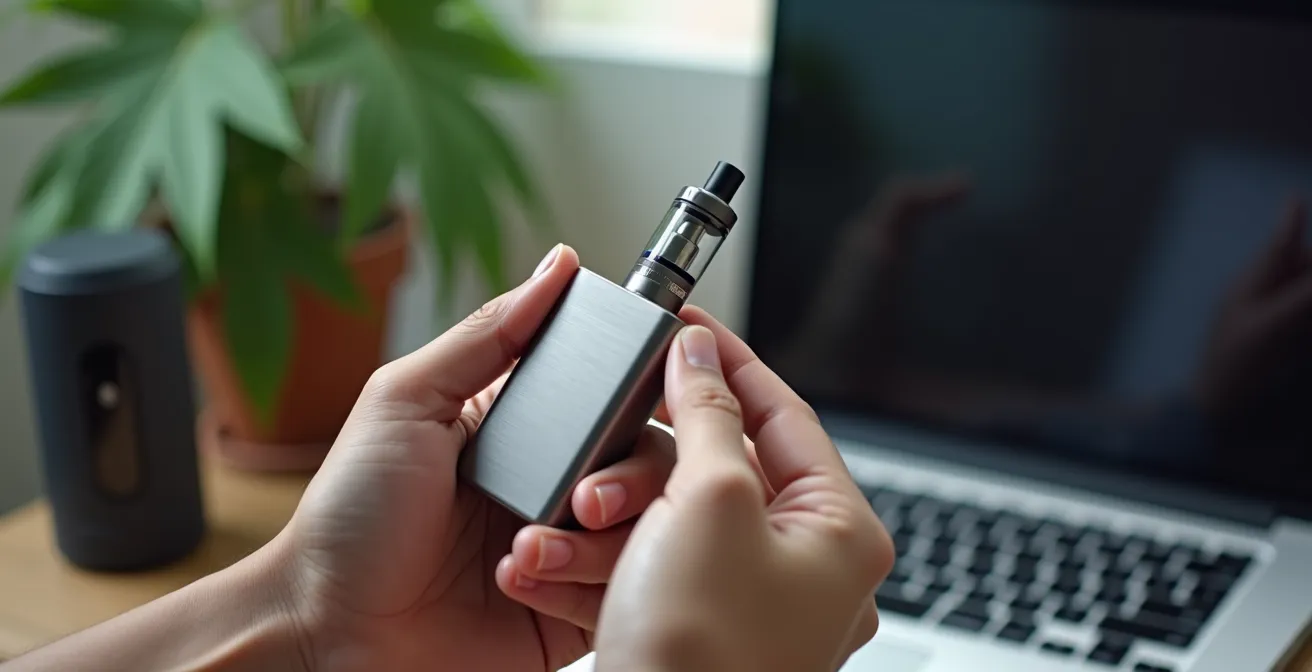
Fortunately, Health Canada maintains a public database of these notifications. Here is how to consult it:
- Access the official site: Go to the Government of Canada portal (canada.ca) and use the search bar with the terms “Vaping Product List – Submissions for Sale.”
- Search for your product: The database allows you to search by brand name, product name, or manufacturer name.
- Check the status: The list will indicate if the product has been submitted. Pay attention to the notification date to ensure it is up to date.
This simple check is the mark of an informed consumer. It guarantees that the product has at least passed the initial Canadian regulatory filter.
This step is another move toward responsible and informed consumption, protecting you from non-compliant products.
Key Takeaways
- Canadian policy is a trade-off between harm reduction for smokers and the imperative protection of youth.
- Health Canada officially recognizes that vaping is less harmful than cigarettes but refrains from actively promoting it.
- Regulations (TVPA) are strict and evolving, as shown by the introduction of the 20 mg/mL nicotine cap.
- For the consumer, it is crucial to choose products notified to Health Canada and to know how to decipher health information.
Clickbait title vs actual study: how to decipher health info without panicking?
The debate on vaping is often polluted by poor quality information, alarmist headlines, and studies taken out of context. For the citizen looking to stay informed, it is easy to feel lost or even panic when faced with headlines about “vaper’s lung.” Learning to decipher health information is therefore an essential skill, particularly in such a polarized field.
The outbreak of e-cigarette or vaping use-associated lung injury (known by the acronym EVALI) in the United States in 2019 is a perfect example. Media outlets quickly created a climate of fear but often omitted crucial details. As specified by the Lung Association of Canada, these cases, while serious, remained rare and were mostly linked to the use of vaping products containing THC (the psychoactive substance in cannabis) and vitamin E acetate, often purchased on the illicit market. Failing to make this crucial distinction between regulated nicotine products and illicit THC products created damaging confusion.
To avoid falling into the trap of misinformation, one must adopt a critical and systematic approach. This involves developing a sort of intellectual “first aid kit” to evaluate the credibility of new health information.
Your action plan for deciphering health info
- Source verification: Is the source a government agency (canada.ca, inspq.qc.ca), a recognized university, or does it represent an interest group or a tabloid media outlet? Always prioritize primary and institutional sources.
- Expert identification: Is the quoted expert a Canadian university researcher active in the field, or someone whose affiliation is unclear? Beware of self-proclaimed “experts.”
- Context analysis: Does the article make the crucial distinction between the risks for an adult smoker who is switching products and those for a non-smoking adolescent who is starting to vape? A lack of nuance is a red flag.
- Consult the original: If a press article quotes a “study,” make the effort to find the original report on the institution’s website (e.g., Health Canada, CCSA) rather than relying on media interpretations that may be simplified or biased.
- Cross-reference reliable sources: Compare the information with what other reliable sources say, such as the Canadian Centre on Substance Use and Addiction (CCSA) or the University of Ottawa Heart Institute.
By adopting these habits, you will move from being a passive consumer of information to an informed actor in your own health, capable of distinguishing scientific fact from a title designed to generate clicks.