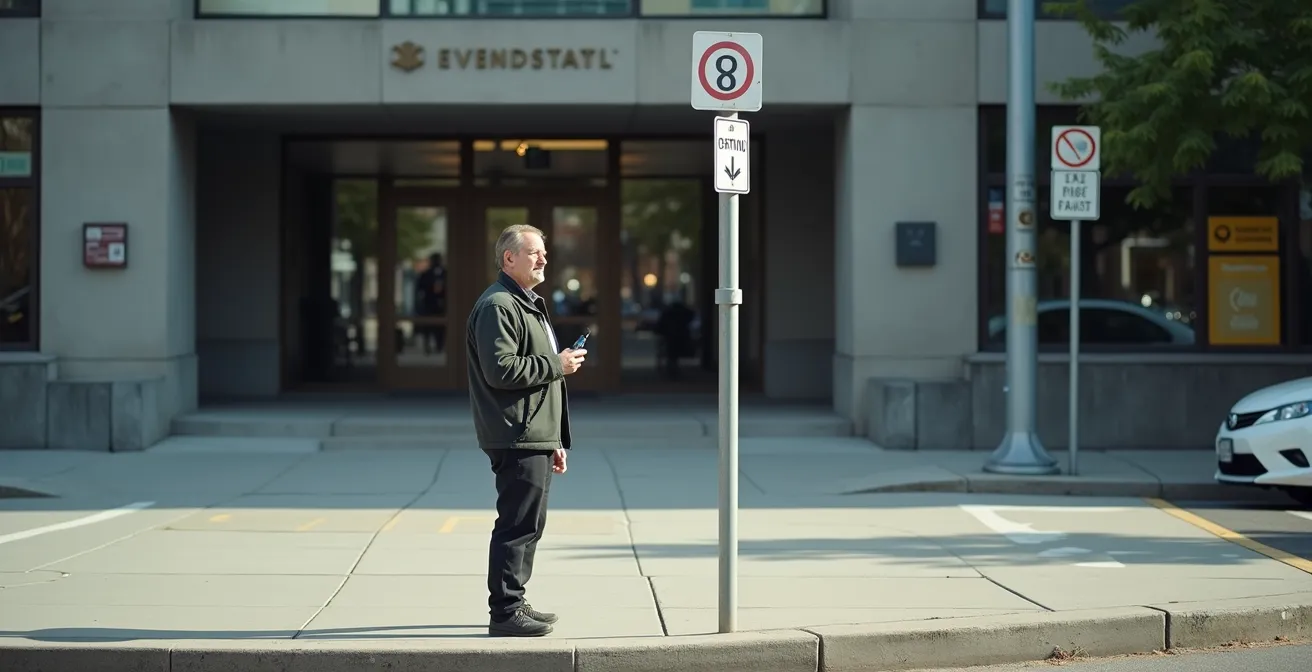
The right to vape in Canada is not a matter of location, but of jurisdiction: the applicable rule depends on who owns the space (federal government, province, municipality, or private owner).
- Federal laws apply to federal workplaces, with a strict ban and high fines.
- Provinces regulate public spaces (health, education) and specific situations like the presence of minors in vehicles.
- An owner or employer has the right to impose stricter rules than the law on their own premises.
Recommendation: Before vaping, identify which jurisdiction the location belongs to. This simple reflex is the key to avoiding any infractions.
The Canadian urban landscape is a real puzzle for any vaper concerned with following the law. Between a crowded sidewalk, a café terrace, and a neighborhood park, the rules seem to change at every corner. While it’s generally known that vaping is prohibited near schools or in hospitals, the reality is far more complex. This confusion often leads to costly mistakes, as a puff of vapor in the wrong place can result in a fine much higher than the price of an e-liquid.
Most guides simply list basic prohibitions, often wrongly equating smoking rules with vaping rules. However, while similar, they contain crucial nuances. The real key to navigating this is not memorizing an endless list of locations, but understanding a fundamental principle: the overlap of regulations. In Canada, your right to vape is governed by a hierarchy of rules ranging from the federal level to the bylaws of your own building.
This article is not just a list of prohibitions. It was designed as a reading grid by an urban regulation expert to teach you how to “read” any public or private space. We will deconstruct, layer by layer, the logic behind each ban: from the steps of a government office to your own balcony, including sports fields and your workplace. By mastering this logic of jurisdiction, you will no longer wonder if you have the right; you will know how to identify the rule that applies.
To guide you through this regulatory labyrinth, this article is structured according to the different layers of power that dictate where and when you can vape. By going through each section, you will develop the compliance reflex that will save you a lot of trouble.
Summary: The Guide to Authorized Vaping Zones in Canada
- Why is moving away from the door of a federal building mandatory?
- Provincial law: why is vaping while driving with a 15-year-old child prohibited?
- Housing lease: can the landlord ban vaping in your apartment?
- The mistake of believing that the outdoors allows vaping on sports fields
- Break room or sidewalk: how to know where your work’s smoking area is?
- Why can vaping less than 9 meters from a door cost you dearly?
- The “stealth vaping” technique to release no visible vapor
- Why have age verification measures become draconian online and in-store?
Why is moving away from the door of a federal building mandatory?
The first regulatory layer, and often the most overlooked, is the federal government. This jurisdiction does not apply everywhere, but it is the strictest where it is in effect. It mainly concerns federally regulated workplaces. Think of Service Canada offices, Armed Forces bases, border crossings, or certain national museums. In these places, the law is not just a recommendation; it is absolute.
The reason for this rigor is twofold: to protect the health of federal employees and the public, and to maintain a professional and neutral environment. The law was designed to eliminate all exposure to smoke and vaping aerosols, considering that even passive exposure near entrances is unacceptable. According to the Tobacco and Vaping Products Act, failure to comply with these rules can result in fines of up to $5,000 for individuals. This is a deterrent penalty that highlights the seriousness with which the federal government treats this issue.
It is not enough to simply step out of the building. You must ensure you are beyond the compliance perimeter, which is clearly defined. For an urban dweller, knowing how to identify these zones and respecting distances is the first step to vaping legally.
Action Plan: Your Checklist for Respecting Federal Zones
- Locate the buildings: Identify workplaces under federal jurisdiction (Service Canada offices, CBSA border crossings, certain national museums, military bases).
- Measure the minimum distance: Ensure you are at least 9 meters away from any door, operable window, or air intake of the building. This is roughly equivalent to the length of two SUVs parked bumper to bumper.
- Check the signage: Federal buildings are required to display clear signs indicating the ban on smoking and vaping. Rely on them.
- Position yourself strategically: Stand beyond the legal distance and, as a precaution, out of the direct line of sight of entrances and security guards.
- Know the penalties: Keep in mind that the potential fine can reach several thousand dollars, which justifies increased vigilance.
Provincial law: why is vaping while driving with a 15-year-old child prohibited?
Just below the federal layer is provincial regulation, the one citizens encounter most often. Each Canadian province and territory has the power to enact its own vaping laws, primarily with a public health objective. These laws aim to protect non-vapers, particularly the most vulnerable like children, from exposure to aerosols.
The ban on vaping in a vehicle in the presence of a minor is one of the most emblematic measures of this protection. A vehicle is an enclosed and cramped space where the concentration of aerosols can quickly become high. Prohibiting vaping in this context aims to prevent passive exposure and avoid normalizing this habit among young people. The age limit varies slightly from province to province, but the principle remains the same: protecting minors in confined spaces.
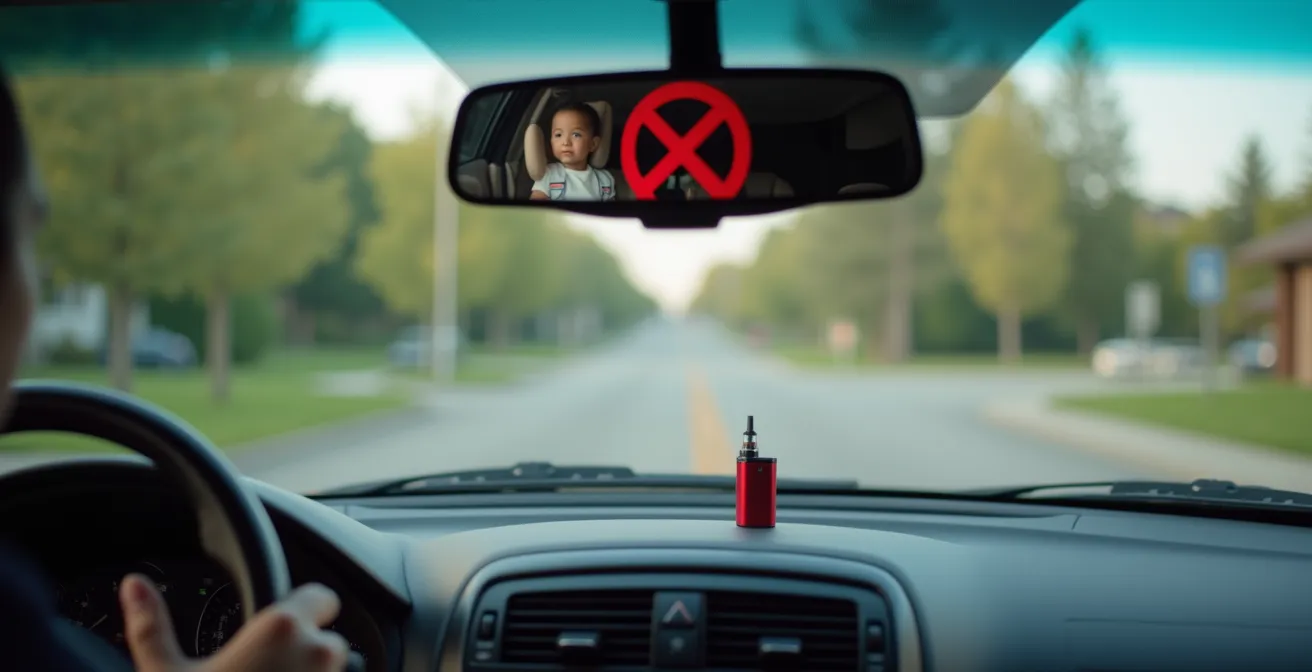
As this symbolic image shows, the law creates a protective bubble around the child. Non-compliance with this rule is not trivial, and financial penalties can be significant, varying considerably from one province to another. Understanding these variations is essential for any citizen traveling across the country.
The following table illustrates the differences in penalties for this specific infraction, as detailed in a comparative analysis of provincial regulations.
| Province | Age of protected minor | Fine (1st offense) | Fine (repeat offense) |
|---|---|---|---|
| Ontario | Under 16 years old | Up to $250 | Variable |
| Quebec | Under 16 years old | $250 to $750 | $500 to $1,500 |
| Alberta | Under 18 years old | Up to $1,000 | Variable |
| British Columbia | Under 16 years old | Variable | Variable |
Housing lease: can the landlord ban vaping in your apartment?
We move down one step in the hierarchy of rules to address the private domain, specifically your place of residence. This is where many vapers feel safe, thinking “home is home.” However, the legal reality is more nuanced, especially for tenants or co-owners. A landlord or a condo association has the full right to impose restrictions on vaping that are stricter than provincial law.
The question is therefore not whether provincial law allows vaping in housing, but what your lease or condo bylaws say. If a “smoke-free” or “vape-free” clause is clearly written in and you have signed it, it has the force of law between you and the landlord. This ban can apply to your apartment, your balcony, and even the common outdoor areas of the building. Failure to respect this clause constitutes a breach of contract and can lead to warnings, penalties, or even a request for lease termination at the Administrative Housing Tribunal.
The logic behind this power is to allow owners to guarantee a healthy and pleasant environment for all residents, some of whom may be sensitive to odors or aerosols, and to prevent potential damage to the housing. As the Government of Quebec points out, the law establishes a minimum standard but does not limit stricter private agreements.
Vaping is prohibited in the common areas of residential buildings with two or more dwellings, whether it is a co-ownership or not. More restrictive measures may apply depending on the building’s bylaws.
– Government of Quebec, Tobacco Control Act
The mistake of believing that the outdoors allows vaping on sports fields
After federal, provincial, and private, another layer of regulation greatly influences urban life: the municipal level. Cities have the power to regulate vaping use in their public spaces, including parks, playgrounds, and sports facilities. A common mistake is thinking that “fresh air” is synonymous with total freedom. However, it is precisely in these places of family and sporting gatherings that municipalities are strictest.
The logic is simple: these places are intended for active recreation, health, and family well-being. The presence of vapers can be perceived as contradictory to this vocation. Furthermore, it aims to protect children and non-vapers and avoid creating role models for younger people. Consequently, most large Canadian cities have adopted bylaws that prohibit vaping on sports fields and their immediate surroundings (bleachers, players’ benches, etc.).
Fines for violating these municipal bylaws can be significant. For example, the Smoke-Free Ontario Act, 2017 provides for fines of up to $1,000 for a first offense on a sports field and $5,000 for subsequent ones. It is therefore crucial not to assume that the outdoors is a lawless zone. Rules can vary from one city to another, as shown in the following table.
| City | Parks and Playgrounds | Sports Fields | Min. Distance from Entrances |
|---|---|---|---|
| Toronto | Prohibited on playgrounds and 9m around | Prohibited on fields and 20m around | 9 meters |
| Montreal | Prohibited in play areas and wading pools | Prohibited on fields | 9 meters |
| Vancouver | Variable by park (signage) | Prohibited | 6 meters |
Break room or sidewalk: how to know where your work’s smoking area is?
The workplace is another regulatory microcosm where rules can be confusing. Generally, provincial law prohibits vaping in all enclosed workplaces, which includes offices, factories, warehouses, and break rooms. The question is therefore not *if* you can vape inside (the answer is no), but *where* exactly you can do it outside.
The responsibility for defining a smoking or vaping area lies with the employer, who must comply with provincial law. This area must imperatively be located outside and respect the minimum distance of 9 meters from any door, window, or air intake, so that aerosols do not enter the building. Some employers, for reasons of image, safety, or to accommodate non-smokers, may choose not to designate any zone on their property, effectively forcing employees to go out onto the public sidewalk. An enclosed public space is defined as any part of a building or even a vehicle covered by a roof where the public has access. It is even prohibited to vape in an outdoor shelter having more than two walls and a roof if employees or the public can be there.
If your company’s policy is not clear, the best approach is proactive communication. Asking for clarification from human resources or your manager is not an admission of fault, but a demonstration of your willingness to follow the rules. Here is a simple strategy to clarify the situation:
- Consult official documents first: Look for the smoking and vaping policy in the employee handbook or on the company intranet.
- Identify the right contact: The HR department is responsible for policies, while the facilities manager knows the physical layout of the premises.
- Phrase your request positively: Approach the person saying, “I want to make sure I follow company rules regarding vaping zones, could you point me to the designated area?”.
- Suggest solutions: If no zone exists, you can suggest a location that respects the 9-meter rule, showing your collaborative spirit.
- Document the response: A simple confirmation email of your discussion can avoid any future misunderstandings.
Why can vaping less than 9 meters from a door cost you dearly?
If only one rule should be remembered from the entire Canadian regulatory labyrinth, it would be this one: the 9-meter rule. This distance, equivalent to about 30 feet, has become the standard in most provinces, including Quebec and Ontario, for defining the no-vaping perimeter around the entrances of most public and professional places.
The logic behind this specific number is scientific. Studies on the dispersion of smoke and aerosols have shown that a distance of 9 meters is necessary to significantly reduce the probability of particles entering a building through doors, windows, or ventilation systems. This is a pragmatic public health measure aimed at effectively protecting people inside. According to Quebec regulations, this minimum distance of 9 meters is mandatory for health establishments, schools, and many other enclosed places open to the public.
The problem is that 9 meters is a difficult distance to visualize. Many people underestimate this length and stand too close, exposing themselves to a fine without even realizing it. To make this rule concrete and easy to apply, here are some simple visual markers:
- Two sport utility vehicles (SUVs) parked bumper to bumper.
- The approximate width of a standard neighborhood ice rink.
- Approximately 12 long strides for an average-sized adult.
- The length of three parking spaces put end to end.
- The typical distance between two telephone poles in an urban area.
The “stealth vaping” technique to release no visible vapor
Faced with multiplying bans, some vapers have developed techniques to minimize or even eliminate visible vapor during exhalation. Known as “stealth vaping,” this practice involves taking a puff and then holding the vapor in the lungs for several seconds before exhaling slowly. The vapor is then almost entirely absorbed and becomes invisible.
However, it is crucial to understand a fundamental legal distinction: discretion does not equal legality. In a place where vaping is prohibited, such as a bus or a waiting room, the infraction is the act of vaping itself, and not the production of a vapor cloud. A security guard or inspector who sees you bringing the device to your mouth in a prohibited zone can fine you, whether vapor is visible or not. “Stealth vaping” therefore does not protect you in any way from a fine in a prohibited location. It is an error of judgment that can be costly.
Where this technique may be of interest is in areas where vaping is legally authorized, but where one wishes to show discretion out of courtesy to people nearby. For those who choose this approach in a legal setting, certain equipment choices can help:
- Prioritize compact “pod systems” rather than large “mods” designed for massive vapor production.
- Choose e-liquids with a higher PG/VG ratio of propylene glycol (PG), which naturally produces less vapor.
- Reduce the power (wattage) of the device if it is adjustable.
- Apply the retention technique by holding the vapor for 3 to 5 seconds before exhaling.
- Only use this method in areas where vaping is explicitly authorized to avoid bothering others.
Key Takeaways
- Vaping regulation in Canada is a overlap of rules: federal, provincial, municipal, and private. The strictest rule always applies.
- The 9-meter distance from entrances is a near-universal standard in public and professional places. Learn to estimate it visually.
- Stealth vaping does not protect you from a fine in a prohibited zone, as it is the act of vaping that constitutes the offense, not the visibility of the vapor.
Why have age verification measures become draconian online and in-store?
The last piece of the regulatory puzzle concerns access to vaping products. Vapers, whether new or experienced, have all noticed a significant tightening of age verification procedures, whether in physical stores or during an online purchase. This evolution is not a result of chance or excessive zeal from retailers, but a direct response to a major public health concern: the increase in youth vaping.
The data is clear and has pushed legislators to act. According to the Canadian Tobacco and Nicotine Survey, nearly 30% of young Canadians aged 15 to 19 reported having ever tried vaping in 2022. Faced with this trend, federal and provincial governments have strengthened obligations for retailers to ensure that vaping products do not fall into the hands of minors.
Consequently, retailers are now required by law to systematically check photo ID for anyone appearing to be under 25. For online sales, robust systems have been put in place, such as Canada Post’s “Proof of Age” option, which requires the recipient to present valid ID at the time of delivery. Failure to comply with these rules exposes businesses to heavy fines, suspension, or even withdrawal of their sales license. The measures you perceive as “draconian” are actually a reflection of the legal responsibility weighing on merchants.
To navigate the Canadian landscape serenely, the next step is to integrate this jurisdiction reading grid into your habits. Before taking out your device, take a second to analyze your environment: am I in front of a federal office, in a municipal park, on my employer’s property? This simple reflex is the best guarantee for vaping legally and with peace of mind.