
Contrary to popular belief, the success of your smoking cessation does not depend on finding a fruity flavor to “forget” tobacco, but on securing the transition with a “Classic” flavor that meets your psychological anchors.
- Choosing a “Classic” e-liquid (such as RY4 or Dry Tobacco) is not just a matter of taste, but a substitution of the ritual and the throat sensation (the “hit”).
- Dual use (smoking and vaping) is not a failure, but a manageable transition stage that, when handled correctly, consolidates the process of quitting cigarettes.
Recommendation: Focus first on replicating your rituals (morning coffee, breaks) with a Classic flavor and a satisfying “hit” before even thinking about exploring other types of aromas. This is the key to realistic and lasting cessation.
You have decided to switch to electronic cigarettes to crush your last cigarette, but one question is holding you back: which flavor should you choose? The idea of replacing your familiar tobacco taste with strawberry vapor, icy mint, or cheesecake seems absurd, even infantilizing. You are not alone. For many smokers, this taste barrier is a major obstacle because it in no way corresponds to the ritual and sensory experience they seek to leave behind without completely disowning.
Common advice is often to turn to radically different tastes to “break” the habit. However, for the smoker deeply rooted in their habits, this approach is often counterproductive. The frustration of not finding familiar benchmarks can quickly lead to the erroneous conclusion that “vaping doesn’t work.” But what if the true key wasn’t to flee the taste of tobacco, but instead to use it as a psychological transition bridge? What if success didn’t reside in searching for a “pleasure” flavor, but in a “realistic” flavor that secures the transition?
This article adopts a realistic tobacco specialist’s approach, specifically designed for you—the smoker who cannot imagine vaping anything other than a familiar taste. We will deconstruct the myth of the perfect flavor to focus on a much more effective strategy: using “Classic” (tobacco) flavors as a psychological substitution tool. It is not about finding a clone of your old brand, but about understanding how an RY4 or a Dry Tobacco can fill the gaps left by quitting cigarettes, far beyond just the taste. We will look at how to manage the transition, adjust sensations, and finally, perhaps, open yourself up to other horizons once your victory over tobacco is consolidated.
To guide you through this strategic process, this article is structured to progressively answer all your questions. You will discover how to choose your first e-liquid, understand essential technical aspects, manage the transition phase, and finally, evolve your vaping experience.
Summary: The Psychology of Tobacco Flavor for Successful Cessation
- RY4 or Dry Tobacco: which one best mimics your usual cigarette brand?
- Chemical vs. Natural: why real leaf extracts gunk up your coils?
- Which flavor profile should you choose to go with your morning coffee?
- The mistake of staying stuck on tobacco when fruits might satisfy you more
- Why tobacco vaping will never taste exactly like combustion?
- Why the throat hit is necessary to satisfy the brain?
- Smoking and vaping at the same time: is it a failure or a stage?
- When to switch from fruity to dessert flavors to reset your taste buds?
RY4 or Dry Tobacco: which one best mimics your usual cigarette brand?
The first step for a smoker is to find a benchmark. The mistake would be to look for a perfect imitation of your brand; that is impossible. The goal is to find a substitute flavor profile that fills the psychological anchor. The two main families available to you are Dry Tobaccos and RY4s. Dry Tobacco is direct, neutral, and no-frills, closely resembling a raw tobacco flavor. RY4, on the other hand, is a Classic tobacco to which subtle notes of vanilla and caramel have been added. This complexity is no accident: it aims to compensate for the absence of the thousands of sweet additives and flavor enhancers present in a combustible cigarette, which create a large part of the satisfaction.
To make an informed choice, you must understand what each profile provides. The following table breaks down their characteristics to help you situate yourself, particularly in relation to popular brands in Canada.
| Feature | RY4 | Dry Tobacco |
|---|---|---|
| Flavor Profile | Classic tobacco + vanilla + caramel | Neutral Classic without sweet notes |
| Complexity | Multi-layered, evolves in the mouth | Linear, constant |
| Cigarette Equivalence | Du Maurier, Player’s Light | Export ‘A’, strong cigarettes |
| Throat Sensation | Soft and round hit | More pronounced and direct hit |
| Psychological Adaptation | Better for filling the void of additives | Closer to pure combustion |
This choice is even more strategic in a context like Quebec where, since late 2023, only tobacco flavors are authorized for sale in shops. This restriction pushes vapers to explore the richness of “Classic” flavors. An RY4, with its complexity, becomes more than just a liquid: it is a legal workaround strategy to obtain superior taste satisfaction while respecting the law. It recreates a sensory richness that prevents boredom and the feeling of deprivation, two major factors in relapse.
Chemical vs. Natural: why real leaf extracts gunk up your coils?
In your quest for authenticity, you might be tempted by “natural” e-liquids derived from the maceration of real tobacco leaves (NET – Naturally Extracted Tobacco). The idea is attractive, but in practice, it often leads to frustration. These natural extracts contain sugars and complex organic compounds that, under heat, caramelize very quickly on the coil of your electronic cigarette. The result? A persistent burnt taste, reduced vapor production, and the need to change your coil every two or three days, which creates discouraging costs and maintenance for a beginner.
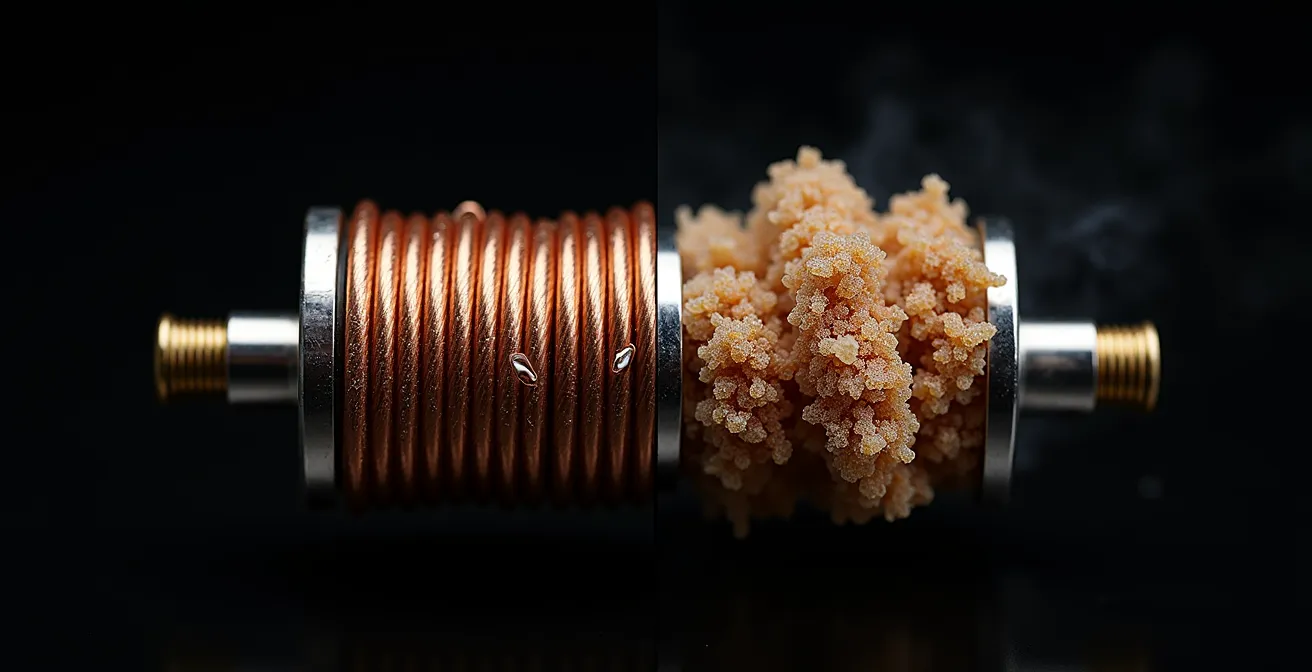
Conversely, “chemical” or synthetic flavors are designed to be pure and stable. They reproduce the key molecules of tobacco flavor without the impurities that cause gunking. A liquid based on synthetic aromas will preserve your equipment much longer, guaranteeing a reliable and consistent experience, which is essential during the first weeks of cessation. As noted by smoking cessation expert Dr. Jean-François Etter, equipment reliability is a key success factor.
The gunking caused by the caramelization of natural sugars in tobacco extracts can push the new user back toward cigarettes, which are perceived as more reliable
– Dr. Jean-François Etter, University of Geneva – Study on Vaping Adherence
To avoid technical frustration and focus on your cessation, it is therefore crucial to make the right equipment choices from the start. Opting for synthetic Classic flavors is a guarantee of peace of mind. Additionally, a few simple steps can extend the life of your coils and ensure an optimal experience, free from unpleasant tastes that could make you doubt your progress.
Which flavor profile should you choose to go with your morning coffee?
The morning cigarette with coffee is often the hardest to give up. It’s not just a dose of nicotine; it’s a deeply anchored ritual, a powerful neurological association. Attempting to replace it with a fruity flavor can create cognitive dissonance: the brain doesn’t understand this unexpected taste signal. The most effective strategy is to create a new positive reward loop. This is where the RY4 profile (tobacco, caramel, vanilla) shows its full potential. Its roasted and dessert-like notes enter into perfect synergy with the bitterness of coffee.
This association is so relevant that it is often recommended by Canadian cessation programs. For example, as part of the “Quit to Win! Challenge,” participants who substitute their morning cigarette with RY4 vaping alongside their coffee report a significantly higher success rate. Reproducing the ritual with a complementary flavor, like the traditional Tim Hortons “double-double,” allows you to gently trick the brain. You aren’t removing the ritual; you are replacing it. This pragmatic approach is even more crucial when we know that nearly 50% of Quebec vapers vape daily, highlighting the importance of established habits.

Choosing a Dry Tobacco can also work, but it will be “rawer” and less comforting. RY4 offers a roundness and complexity that fills the sensory void left by the cigarette more completely. For coffee, but also after meals or during breaks, RY4 acts as a genuine ritual substitute, far more than just a nicotine substitute.
The mistake of staying stuck on tobacco when fruits might satisfy you more
While starting with a Classic flavor is a winning strategy, staying with it indefinitely can be a mistake. The tobacco flavor is a transition bridge, not a final destination. Its role is to help you get through the hardest part: the first few weeks without combustion. Once the act of smoking is replaced by the act of vaping and the dependence on cigarette additives has decreased, your palate and brain are ready for the next step: complete dissociation from the taste of tobacco.
Statistics show that preferences evolve with vaping experience. According to a Canadian survey, 65% of young vapers prefer fruits, compared to only 48% among those aged 25 and older, who are more likely to be former smokers in a transition phase. Staying “stuck” on a tobacco flavor can maintain a counterproductive nostalgia. Moving to fruity or dessert flavors once the cessation is consolidated (generally after 4 to 6 weeks) sends a strong signal to your brain: “I am no longer a smoker, I am a vaper.” This is the final stage of psychological substitution.
In Quebec, despite the ban on flavors in shops, the demand for this transition is so strong that a parallel market for “flavor enhancers” has developed. These small bottles of concentrated aromas allow vapers to add fruity or dessert notes to their legal tobacco liquid base. This demonstrates a fundamental need: once the initial need for security is met by the Classic flavor, the need for novelty and pleasure takes over to prevent boredom and consolidate long-term cessation.
Why tobacco vaping will never taste exactly like combustion?
This is one of the first disappointments for a smoker switching to vaping: “it doesn’t taste the same.” and that is normal. It is crucial to accept a fundamental truth: a tobacco-flavored e-liquid can never reproduce the taste of a cigarette. The reason is simple: what you call the “cigarette taste” is not just the taste of the tobacco leaf. It is the complex result of the combustion of over 4,000 chemical substances, including paper, tars, flavoring agents, texture agents, and many additives designed to reinforce addiction.
Vapor from an electronic cigarette, however, contains only a few ingredients: propylene glycol (PG), vegetable glycerin (VG), food-grade flavorings, and nicotine. There is no combustion, no tar, no carbon monoxide. Looking for the taste of smoke in vapor is like looking for the taste of a charcoal-grilled steak in a steamed steak: the base ingredient is the same, but the process changes everything.
The goal is therefore not imitation, but satisfactory substitution. You must retrain your brain to accept new signals: the warmth of the vapor, the throat sensation (the “hit”), and a flavor profile that evokes tobacco without trying to clone it. By accepting this difference, you free yourself from an unrealistic expectation that can only lead to frustration. You then focus on the real goal: a harm reduction method that, according to British health authorities cited by Health Canada, is at least 95% less harmful than traditional cigarettes. It is worth the effort, even if the taste isn’t exactly identical.
Why the throat hit is necessary to satisfy the brain?
For a smoker, satisfaction doesn’t just come from the taste or the nicotine, but also from a very specific physical sensation: the “throat hit,” that tingling or contraction at the back of the throat when inhaling smoke. This signal is a powerful neurological conditioning. Your brain has associated it for years with receiving its dose of nicotine. Without this “hit,” the experience seems incomplete, “empty,” even if the nicotine level is sufficient. This is why an e-liquid can taste delicious but not satisfy you if it doesn’t produce the right sensation.
The good news is that the “throat hit” is entirely adjustable in vaping. It mainly depends on two factors: the level of propylene glycol (PG) and the concentration of “freebase” nicotine (the classic form, different from nicotine salts). A liquid with a PG/VG ratio of 60/40 or 70/30 will produce a much more marked hit than a liquid rich in vegetable glycerin (VG), which softens the vapor. Similarly, a nicotine level of 12mg/ml will produce a stronger hit than a level of 6mg/ml. It is therefore crucial to adjust these parameters to match your profile as a former smoker.
In Canada, the popularity of closed systems (like Vuse or STLTH) has highlighted nicotine salts, which offer a much smoother hit for a high nicotine level. This is ideal for some, but for a former smoker of strong cigarettes, this lack of “punch” can be confusing. It is therefore essential not to just accept default settings, but to take control of this sensation so it meets your expectations. It is a parameter of your cessation as important as the choice of flavor.
Your Action Plan for a Perfect ‘Hit’
- Evaluate your dependence with the Fagerström test to determine your initial nicotine needs.
- For a pronounced hit (if you smoked strong cigarettes), choose an e-liquid with a high PG ratio (60/40 or 70/30).
- If you use popular closed systems in Canada (Vuse, STLTH), opt for the maximum authorized concentration of 20mg/ml in nicotine salts to maximize the sensation.
- If your device is adjustable, adjust the power: more watts (power) increase the hit with freebase nicotine e-liquids.
- Test different concentrations: start with a level corresponding to your consumption (e.g., 12-18mg for a heavy smoker, 6mg for a light smoker) and adjust if the sensation is too strong or too weak.
Smoking and vaping at the same time: is it a failure or a stage?
You have started vaping, but you can’t quite let go of the cigarette completely. You feel guilty; you think it’s a failure. This is an erroneous and guilt-inducing view of cessation. Dual use, or “vapofumage,” should not be seen as a failure, but as a pragmatic transition phase. Very few smokers quit overnight. Most often, the shift happens gradually, replacing cigarettes one by one. Every cigarette not smoked is a victory, not a defeat.
In 2022, 12% of Canadians aged 15 and older still smoked cigarettes. Moving away from this figure takes time and strategy. Dual use allows for gentle learning: you get used to the equipment, you adjust your nicotine level, you find the flavor that works for you during key moments, all while keeping the “crutch” of the cigarette for the most difficult situations. The goal is not to stay in this situation, but to use it as a springboard.
The key is to structure this transition with a plan. Instead of suffering through dual use, organize it. Consciously decide which cigarettes you will replace with vaping each week. Start with the “easiest” ones (the one in the car, the one after a meal) and progress toward the most “difficult” ones (the morning cigarette, the one in stressful situations). This method of progressive substitution transforms a sense of failure into a controlled action plan, considerably increasing your chances of final success.
Progressive Substitution Method to Move Away from Dual Use
- Week 1: Systematically replace the after-meal cigarette with vaping.
- Week 2: Add the replacement of the morning cigarette to your goal.
- Week 3: Substitute all cigarettes taken during work breaks.
- Week 4: Keep only 2 or 3 “pleasure cigarettes” per day, the most important ones for you.
- Week 5: Attempt to go a full day without any cigarettes, then two.
- Week 6: Goal: total cessation of cigarettes. You are now exclusively a vaper.
Key Points
- The “Classic” flavor is not an imitation, but a psychological substitute for the smoker’s ritual, making it ideal for starting out.
- Throat satisfaction (the “throat hit”) is a neurological signal as important as taste or nicotine for successful cessation.
- Dual use (smoking and vaping) is not a failure. It is a normal and manageable transition phase that, when well-structured, leads to total cessation.
When to switch from fruity to dessert flavors to reset your taste buds?
After several weeks, or even several months, with the same Classic flavor, you might experience some boredom. This is a normal phenomenon, sometimes called “Vaper’s Tongue”: your taste buds become saturated and you perceive the aromas less clearly. This is the perfect signal that it is time to move to the next stage of your journey: exploration. Your addiction to the cigarette ritual is broken; it is time to consolidate your new status as a vaper by diversifying pleasures to prevent boredom from making you look back.
The switch to fruity or dessert flavors is significant. It is a strong psychological act that marks the definitive break with your identity as a smoker. You are no longer looking for a tobacco substitute; you are exploring a new sensory universe. The strategy consists of creating a flavor rotation. Having two or three different e-liquids (for example, your trusted RY4, a mango liquid, and a vanilla cream one) and alternating between them allows you to “reset” your taste buds and maintain a high level of satisfaction.
Even in a restrictive context like Quebec, this rotation strategy remains relevant. Experienced vapers alternate between different types of complex tobacco flavors to avoid monotony. Switching from an RY4 (tobacco-caramel-vanilla) to a “Classic Gourmet” more oriented toward biscuit or coffee notes, for example, allows for novelty while staying within a familiar framework. The important thing is not to let boredom set in, as it is an entry point for relapse.
By applying a progressive substitution method and understanding the psychology behind each step, you transform a path that seems full of obstacles into a clear and achievable action plan. Start putting these tips into practice today to finally succeed in your transition.
Frequently Asked Questions about Transitioning from Tobacco to Vaping with Classic Flavors
What is ‘Vaper’s Tongue’ and how can I avoid it?
Flavor fatigue, or ‘Vaper’s Tongue,’ usually occurs after using the same flavor for 2 to 3 weeks. Your taste receptors become saturated, and you no longer perceive the taste well. To avoid it, the best strategy is to alternate between 2 or 3 e-liquids with different flavor profiles. Also, remember to stay well-hydrated, as dehydration can worsen this phenomenon.
Can I mix tobacco and dessert flavors in Canada?
Yes, absolutely. In most Canadian provinces, you are free to mix or alternate flavors as you see fit. The only notable exception is Quebec, where the sale of flavors other than tobacco is prohibited in shops. In this case, the strategy is to prioritize complex tobacco flavors like RY4, which already integrate dessert notes (vanilla, caramel), offering a richer experience while respecting the legislation.
How long should I wait before changing my flavor profile?
There is no absolute rule, but it is strongly recommended to wait at least 4 to 6 weeks after completely stopping cigarettes before exploring other flavor universes (fruity, dessert, etc.). This initial period is crucial for consolidating your cessation and solidly breaking the psychological dependence on cigarettes. Once this stage is passed, you can begin to experiment to find new flavors that will help you stay away from tobacco in the long term.