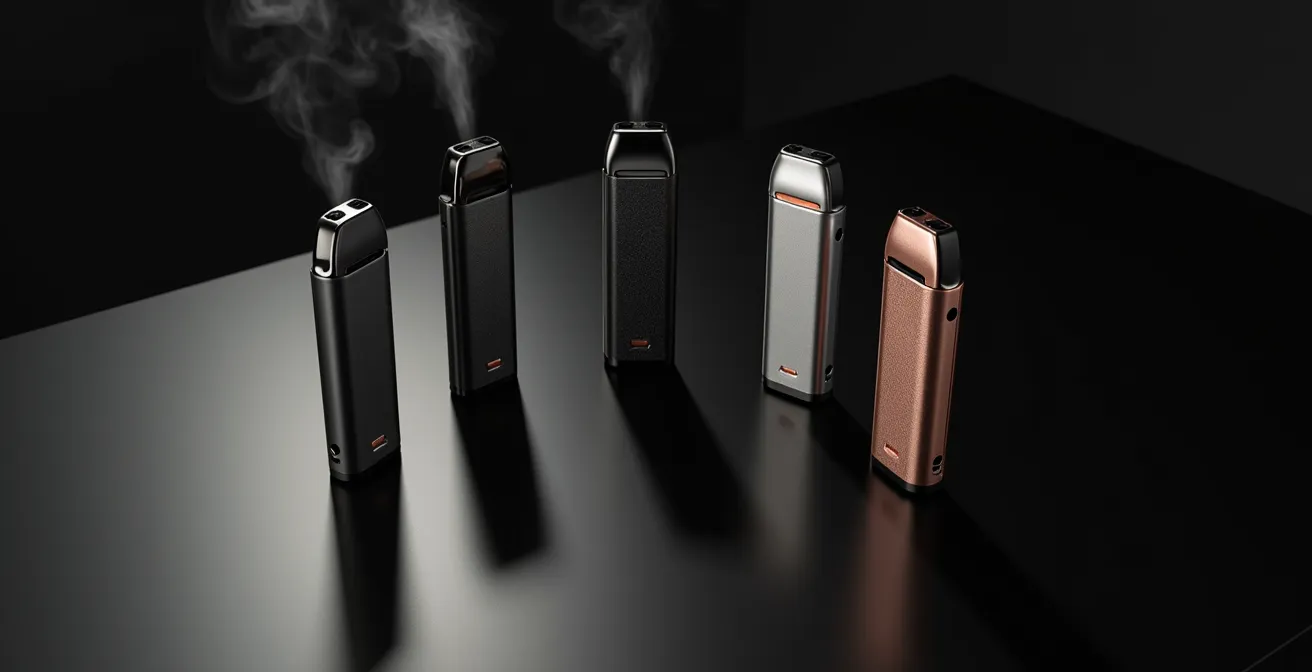
The superiority of the Pod Mod in Canada doesn’t stem from vapor production, but from its economic and material resilience against local constraints.
- It offers a superior cost/performance arbitrage in the face of the new federal excise tax.
- Its maintenance, adapted to the Canadian climate, is the key to its long-term durability and profitability.
Recommendation: Think of your pod mod not as a gadget, but as a system to be managed to maximize its lifespan and minimize your expenses.
For any vaper looking to evolve beyond simple “pens” without the bulk of a massive “box” mod, the pod mod appears to be the obvious solution. This hybrid format is systematically presented as the best compromise between portability and performance. However, this claim, while true, only represents the tip of the iceberg and masks the true reasons for its dominance in the Canadian market. Reducing the pod mod’s success solely to the vaping experience would be an analytical error.
The true strength of this format lies not only in the vapor cloud it produces, but in the intelligence of its hardware ecosystem. Its popularity is explained by how users can manage its life cycle (battery, connectors, cartridges) and make wise economic trade-offs. In a Canadian context marked by a demanding climate, strict provincial regulations, and increasing taxation on vaping products, the ability to maintain, repair, and optimize one’s device becomes a strategic advantage.
This article offers an in-depth analysis that goes beyond simple performance comparisons. We will break down the practical and financial aspects that make the pod mod a choice not just of pleasure, but above all, of reason. We will see how managing its components and understanding its ecosystem can transform your ownership experience and significantly lighten your annual expenses.
To guide you through this strategic analysis, here are the key points we will cover. Each section is designed to give you concrete tools to master your device and get the most out of it in the Canadian context.
Summary: Analyzing Pod Mod Dominance Through Its Ecosystem
- Auto-draw or manual switch: Which is more reliable over time?
- Why wiping connectors every day saves your battery?
- The mistake of throwing away the whole pod when the internal battery dies
- PnP, GTX, or RPM series: How to avoid the wrong model at the store?
- When to change cartridges to switch from MTL to DL on the same device?
- When to choose an upgradeable kit over a disposable or closed pod?
- Where to dispose of empty pods containing nicotine residue and plastic?
- How to manage your magnetic pods to avoid leaks and pollution?
Auto-draw or manual switch: Which is more reliable over time?
The choice between auto-draw (vacuum-activated) and manual triggering (via a button) seems like a simple matter of preference. However, from a long-term reliability perspective, and specifically within the Canadian climate, the answer is more technical. The auto-draw switch, while convenient, relies on a pressure sensor that is inherently more sensitive to environmental variations. During extreme cold, condensation can form on electronic components when moving quickly between the freezing outdoors and heated indoors. When the mercury drops drastically, this condensation can freeze and block the delicate mechanisms of the sensor, rendering it temporarily or permanently inoperative.
The manual switch, on the other hand, uses a simple physical contact, which is much more robust and less prone to this type of climate-related failure. It offers total control to the user and better resilience against thermal shock. For daily use in Canada, where temperatures can drop below -20°C, the manual switch is objectively more reliable. It eliminates a potential source of failure related to condensation and freezing, ensuring consistent operation regardless of weather conditions. Opting for a manual model, or a hybrid model that allows disabling the auto-draw, is therefore a strategic choice to ensure the longevity of your device.
Why wiping connectors every day saves your battery?
Maintenance of magnetic or clip-in connectors is often neglected, yet it is the most important action to preserve the health and lifespan of your pod mod’s battery. These metal contact points ensure the transfer of energy from the battery to the coil. Any obstruction or corrosion on these connectors creates parasitic electrical resistance. The battery must then provide more energy to reach the requested power, leading to faster discharge and premature wear of its cells. On a daily basis, two enemies threaten these connectors: condensation and e-liquid micro-leaks. These fluids, even in tiny amounts, create an insulating film and, eventually, cause oxidation.
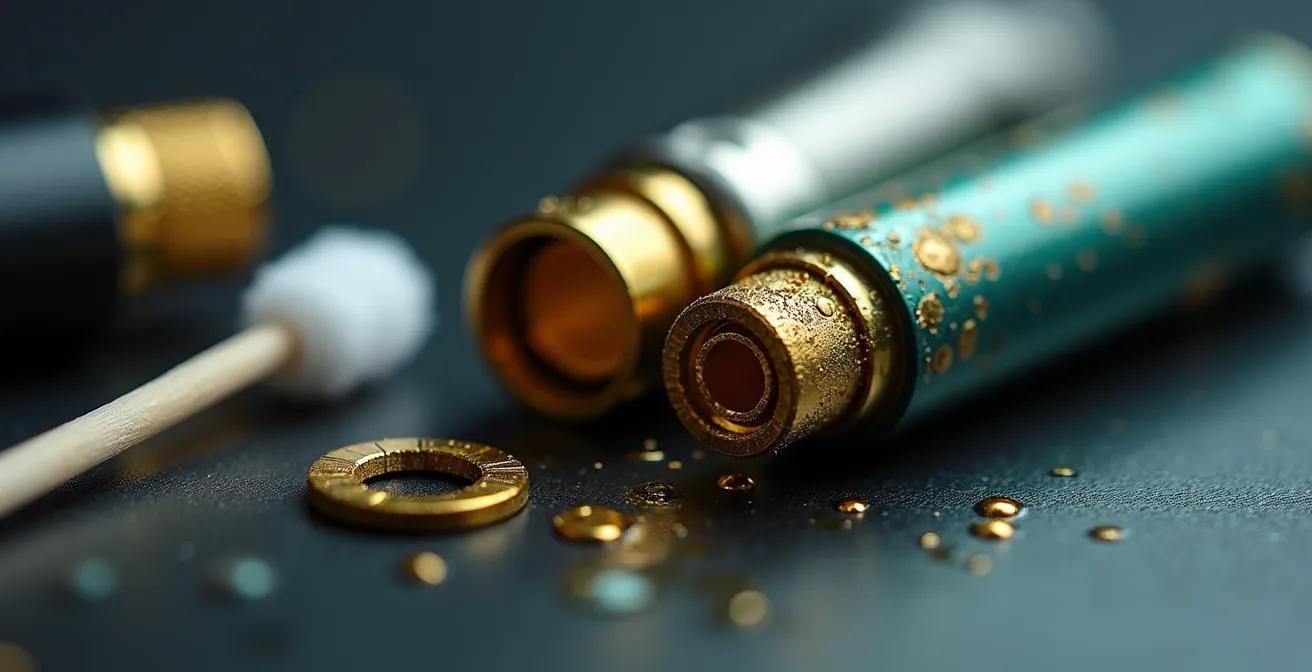
Wiping the connectors daily with a dry cloth or a cotton swab is a preventive action that stops this degradation. This simple gesture guarantees perfect electrical contact, optimal coil heating, and energy consumption faithful to what the manufacturer intended. Economically, preserving your battery is even more crucial in Canada, where the overall cost of vaping is rising. Indeed, with an excise tax that can reach up to $2.24 CAD per 2ml of e-liquid, every dollar saved on premature hardware replacement counts. Rigorous connector maintenance is therefore not just a technical issue, but a real lever for savings.
The mistake of throwing away the whole pod when the internal battery dies
One of the most costly and least ecological mistakes made by pod mod users is viewing the device as a disposable whole. When an internal battery reaches the end of its life (usually after 300 to 500 charge cycles), many users discard the entire device to buy a new one. This is an economic miscalculation and environmental nonsense. Most mid-to-high-end pod mods are designed so that their battery can be replaced, either by a specialized repairer or by the user themselves if they have some technical skills. This option is often ignored because it is perceived as complex or unavailable.
However, a simple financial arbitrage demonstrates the absurdity of throwing away the device. Replacing a battery costs a fraction of the price of a new pod mod, and this operation is not subject to the excise tax on vaping products. In Canada, recycling programs like Call2Recycle’s facilitate not only the safe collection of vapes but also the management of their components. This means there is a system in place to handle used batteries responsibly. Before discarding your device, check local repair options or battery replacement tutorials for your specific model. It’s a decision that directly impacts your wallet and the environment.
The cost-benefit analysis between replacing the device and repairing its battery is clear, especially in the Canadian fiscal context.
| Option | Average Cost | Duration | Excise Tax Impact |
|---|---|---|---|
| New Pod Mod | 50-150 CAD | 1 day | +15-30% in tax |
| Battery Replacement | 20-40 CAD | 3-5 days | 0 (no tax) |
| Local Repair | 30-50 CAD | 2-3 days | 0 (service only) |
PnP, GTX or RPM series: How to avoid the wrong model at the store?
The success of pod mods relies heavily on their coil ecosystems. Manufacturers like Voopoo (PnP), Vaporesso (GTX), and Smok (RPM) have developed interchangeable coil platforms compatible with many devices in their range. This standardization is a major asset, but it can also become a real headache for the consumer. Buying the wrong series of coils in-store is a frequent mistake that makes the purchase useless. To avoid this, it’s not enough to know the brand of your pod; you must know the exact name of the coil platform it uses.
Each platform has its specificities. Voopoo’s PnP coils are renowned for their versatility and excellent performance with tobacco and mint flavors, which are very popular in Canada due to flavor restrictions. Vaporesso’s GTX series is often cited as the benchmark for a tight and flavorful Mouth-To-Lung (MTL) vape. Smok’s RPM ecosystem, meanwhile, is extremely vast and offers a compromise for almost every vaping style. The choice of a pod mod should therefore also be guided by local availability and the cost of coils for its platform. Before investing, it’s wise to verify that compatible coils are easily found in your local shops or on reliable Canadian websites.
Your Action Plan Before Buying in a Canadian Store
- Check compatibility on the Dashvapes or 180 Smoke website before heading out.
- Explicitly ask for flavors compliant with Bill S-5 (tobacco, mint, flavorless).
- Physically test the pod insertion in the store to avoid errors.
- Confirm the local availability of replacement coils.
- Note the exact model number to avoid any future confusion.
When to change cartridges to switch from MTL to DL on the same device?
Many modern pod mods offer the versatility to switch from Mouth-To-Lung (MTL) inhalation, similar to a traditional cigarette, to Direct Lung (DL) inhalation, which is airier and produces more vapor. Technically, this change is made by using coils of different values (high for MTL, low for DL) and adjusting the airflow. However, for an optimal experience and for economic reasons, it is highly recommended not to just change the coil, but to use two distinct dedicated cartridges.
The first reason is the specialization of the cartridge itself. MTL cartridges often have a narrow mouthpiece (drip tip) to concentrate vapor and flavor, while DL ones have a wide tip to maximize air volume. Using the same cartridge for both styles is a compromise that satisfies neither fully. The second reason is purely economic, and particularly relevant with Canadian taxes. MTL is ideal for nicotine salt e-liquids, which are more heavily taxed. DL, however, is practiced with lower nicotine strength e-liquids based on vegetable glycerin, which are less expensive. Separating uses into two distinct cartridges allows you to dedicate the MTL cartridge to more expensive liquids (used in smaller quantities) and the DL cartridge to less-taxed liquids. This strategy can generate up to 40% savings on your e-liquid budget by optimizing consumption against taxation.
When to choose an upgradeable kit over a disposable or closed pod?
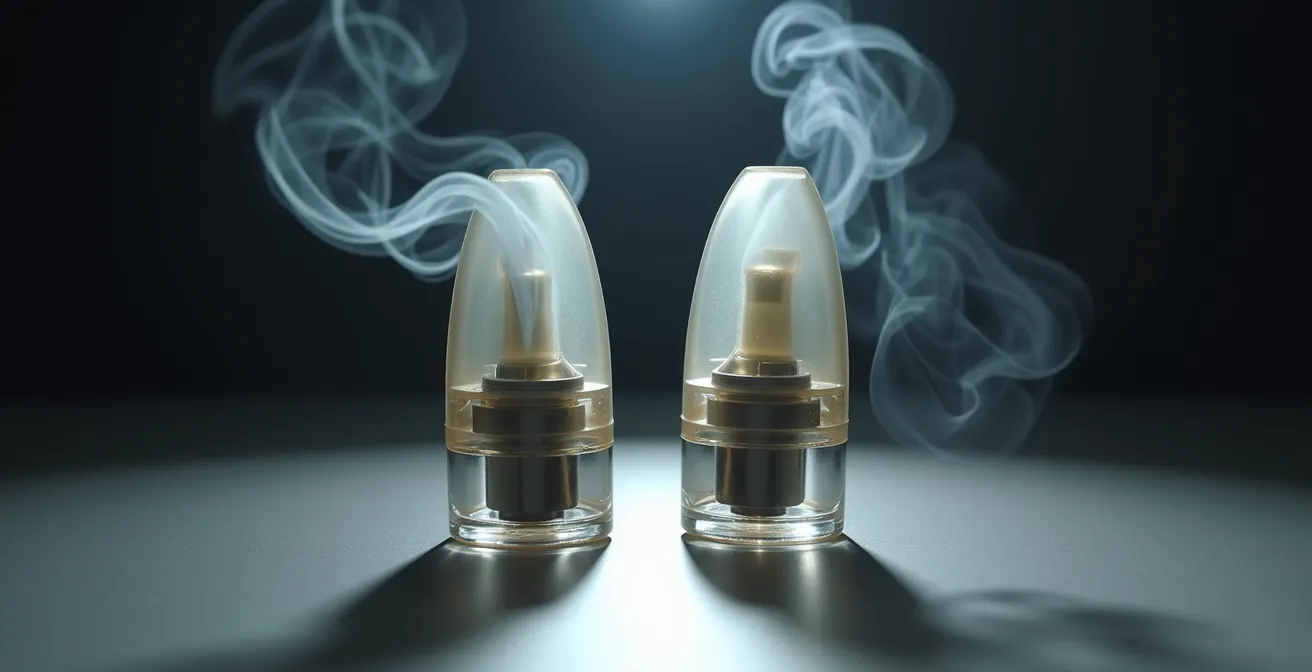
Faced with the apparent simplicity of disposable pods or closed systems (like Vuse or Juul), an upgradeable (or “open”) pod mod may seem more demanding. However, financial and practical arbitrage quickly leans in its favor. Choosing an upgradeable system becomes strategically indispensable as soon as you move beyond very occasional use. The economic break-even point is reached in less than two months: the annual cost of an upgradeable system, despite a higher initial investment, is up to four times lower than that of disposable pods, which are heavily impacted by the excise tax applied to each unit.
Beyond the financial aspect, the upgradeable pod mod offers crucial freedom of adaptation in Canada. With flavor regulations varying from province to province, being trapped in a closed system where the selection is frozen by the manufacturer is a risk. An open system allows you to choose any authorized e-liquid (tobacco, mint, or flavorless) from any brand, offering choice and flexibility that closed systems cannot match. As noted in an economic analysis of the impact of federal taxes, the investment in an upgradeable kit is amortized very quickly. The choice becomes simple: for regular use, the open pod mod is not an option—it is the only economically and practically viable choice.
| System Type | Initial Cost | Annual Cost (with tax) | Break-even Point |
|---|---|---|---|
| Upgradeable Pod | 50-80 CAD | 400-600 CAD | 2 months |
| Disposable Pods | 15-25 CAD/unit | 1800-2500 CAD | – |
| Closed System | 40-60 CAD | 1200-1600 CAD | 4 months |
Where to dispose of empty pods containing nicotine residue and plastic?
Managing the end-of-life of pod cartridges is a major environmental issue. These small objects are a concentrate of complex waste: plastic (PCTG), metal (the coil), and e-liquid residues containing nicotine, a substance toxic to the environment. Throwing them in the household trash is the worst solution, as it guarantees their landfilling and potential soil and water contamination. Similarly, putting them in the regular recycling bin is a mistake, as sorting centers are not equipped to separate these small, contaminated composite elements.
The responsible solution lies in specialized collection channels. In Canada, initiatives are emerging to address this problem. For example, Call2Recycle launched the “Recycle Your Vapes” program in Quebec. As reported in an official program announcement, specific collection containers are deployed in hundreds of vape shops and municipal eco-centers. The correct procedure is as follows:
- Locate the nearest collection point via dedicated sites like recycleyourvapes.ca.
- Empty any liquid residue as much as possible.
- Drop off used cartridges (and the end-of-life device) in the designated bins.
Key Takeaways
- A pod mod’s reliability in Canada depends more on its maintenance against the climate than its technical specs.
- Economic management (repair, MTL/DL choice, open system) is the main lever for reducing the annual cost of vaping in the face of taxes.
- The full life cycle, from coil platform choice to recycling, must be considered for a smart purchase.
How to manage your magnetic pods to avoid leaks and pollution?
The magnets that hold the cartridge to the battery are a key innovation of the pod mod, offering great simplicity of use. However, this magnetic connection requires a minimum of attention to remain effective and avoid two major problems: leaks and accidental loss of the cartridge. The attraction force of the magnets can be compromised by the accumulation of microscopic metal filings. These fine iron dust particles, present everywhere in the environment, are naturally attracted to the magnets and can create a gap between the cartridge and the battery, sufficient to cause micro-leaks or weaken the connection. A weekly cleaning of the magnets with a dry cloth is enough to prevent this problem.
The second risk is losing the cartridge, a significant source of plastic and nicotine pollution. In addition to regular maintenance, a few simple actions, especially in the Canadian climate, can secure the connection. It is advisable to let the pod acclimate for a few minutes when moving from a very cold environment to a warm interior to prevent condensation from lubricating the connection. Furthermore, using a protective case during travel prevents the cartridge from detaching at the bottom of a bag or pocket. Managing your magnetic pods ensures a leak-free experience while preventing avoidable pollution. It is the final link in the chain for responsible and optimized ownership of your device.
Armed with this knowledge of maintenance and economic optimization, you are now ready to choose the pod mod that matches not only your vaping style but also your reality. Evaluate upgradeable options now to take full control of your experience and your expenses.