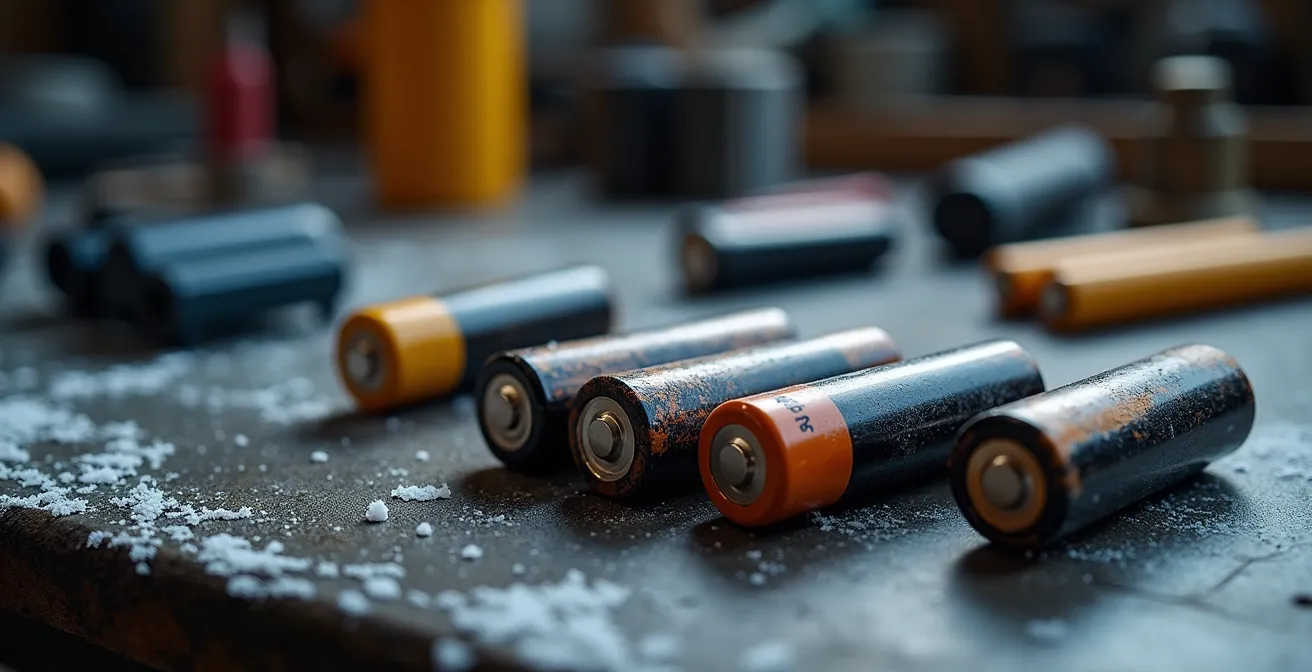
Most battery accidents are not due to chance, but to a lack of knowledge of basic physical laws, exacerbated by Canadian conditions.
- Excessive power demand (Watts) on an unsuitable battery (Amps) creates a physical imbalance leading to critical overheating.
- The Canadian cold increases the battery’s internal resistance, making it more vulnerable, while a simple tear in its plastic wrap can cause a direct short circuit.
Recommendation: Treat every battery as a powerful energy reservoir by systematically checking its compatibility (Ohm’s Law) and physical integrity, and by using an external charger for maximum safety and longevity.
Videos of e-cigarette explosions are spectacular and terrifying. They fuel a legitimate fear: could this object you hold in your hand turn into a dangerous projectile? This fear, if not properly addressed, can lead to two extremes: total abandonment due to anxiety or, worse, ignoring the risk through normalization. Many think safety is just about not putting batteries in a pocket with keys or buying “good brands.” While these tips are valid, they are only the tip of the iceberg. They treat the symptoms without ever explaining the root cause of the failure.
But what if the true key wasn’t following a list of rules by heart, but understanding the physics and chemistry that govern your batteries? The truth is that a battery never explodes “by chance.” It follows predictable physical principles. The problem is often not the device itself, but a breakdown of the delicate balance between battery chemistry, user demand, and environmental constraints—which are particularly demanding in Canada.
This article goes beyond the usual safety instructions. We are going to break down the “why” behind every risk. You will learn why requesting too much power turns a battery into a time bomb, how a simple 1mm tear becomes the source of a short circuit, and why an external charger is much more than just a convenience. The goal is to transform your fear into proactive risk management, giving you the knowledge of an expert to vape with total peace of mind.
To navigate through the crucial aspects of battery safety, this article is structured into several essential points. The summary below will guide you to each key section, allowing you to dive deeper into the topics that concern you most.
Summary: Understanding and Preventing Risks Related to Vaping Batteries
- Why asking for 100W from a 10A battery is a time bomb?
- Dents or arc marks: which visual signs require immediate recycling?
- The mistake of leaving batteries in the mod during 3 months of non-use
- Reliable vs. obscure brands: how to know what’s really under the label?
- What to do (and not do) if your battery starts hissing and heating up?
- Why a 1mm tear in the plastic wrap can cause a short circuit?
- Water, dust, and shocks: which mod survives a fall into the snow?
- USB vs. External Charger: which one doubles the lifespan of your batteries?
Why asking for 100W from a 10A battery is a time bomb?
The incompatibility between requested power (Watts) and the battery’s discharge capacity (Amps) is the number one cause of critical failures. This isn’t an opinion; it’s a physical law: Ohm’s Law. Imagine asking a small city car engine to tow a semi-truck up a hill. It will overheat and fail. That is exactly what happens in your box mod. A battery is designed to provide a maximum current safely; this is its Continuous Discharge Rating (CDR), expressed in Amps (A). Demanding a wattage that requires more amps than the battery’s CDR can provide forces it into overheating.
This overheating initiates a chain reaction in the Lithium-Ion chemistry called thermal runaway. Internal components degrade, release flammable gases, and pressure builds until the metallic casing ruptures violently. This phenomenon is far from anecdotal, with an alarming 195% increase in lithium-ion battery-related fires reported in Montreal between 2022 and 2024. This is proof that the misuse of this technology has very real consequences.
Furthermore, the Canadian context adds a layer of complexity. Extreme cold directly affects the performance of your batteries. As shown in an analysis of vaping risks in Canada, low temperatures increase the battery’s internal resistance, making it less efficient and more likely to heat up during high demand. It is therefore crucial to moderate your power in cold weather.
Your Action Plan: Calculating Your Setup’s Safety
- Identify the Continuous Discharge Rating (CDR) in Amps (A) of your battery, provided by the manufacturer (e.g., 20A).
- Apply Ohm’s Law to find the amperage your vape is demanding: Amps (A) = Power (W) / Voltage (V). The nominal voltage of a battery is approximately 3.7V.
- Example: For 100W, you are demanding 100W / 3.7V = ~27A.
- Compare: If your battery has a CDR of 20A and you are asking for 27A, you are in a zone of imminent danger.
- Corrective action: Immediately reduce your power to a safe level (e.g., 70W, which is ~19A) or use a battery with a higher CDR (e.g., 30A).
Dents or arc marks: which visual signs require immediate recycling?
Even before discussing performance, the first line of defense is visual inspection. A battery is a fragile structure. Its metallic shell contains reactive chemistry under pressure. Any alteration to this structure is a red flag that must never be ignored. The most common danger signs are dents, rust (often due to condensation), and black or burnt marks near the poles, which indicate a past electrical arc.
A dent, even a slight one, can compress the internal layers of the battery, creating a pressure point that risks causing an internal short circuit. Rust, on the other hand, weakens the integrity of the metallic casing, making it more likely to fail in the event of overpressure. These signs are not to be “monitored”; they require the immediate and safe recycling of the battery. Continuing to use a damaged battery is like driving with a tire about to burst.
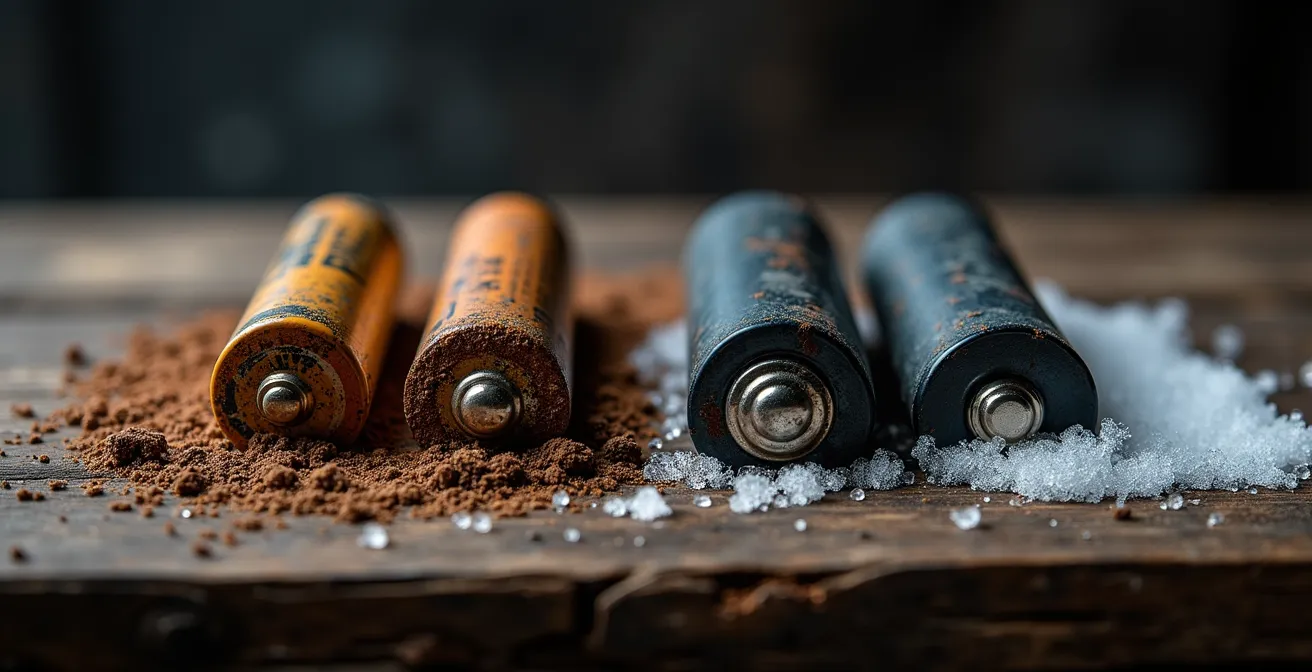
The image above clearly illustrates the difference between a healthy battery and one that has become a threat. The slightest deformation or trace of corrosion must be taken seriously. Fortunately, Canada has implemented solutions to dispose of these dangerous products responsibly.
Case Study: The ‘Recycle Your Vapes’ Program by Call2Recycle
Facing the need to manage end-of-life batteries, Call2Recycle launched the ‘Recycle Your Vapes’ program in January 2025 in Quebec. Unique in Canada, this initiative created a collection network via nearly 200 participating vape shops and eco-centres. This program offers a concrete and safe solution for recycling damaged batteries, preventing them from ending up in household trash where they represent a major fire risk.
The mistake of leaving batteries in the mod during 3 months of non-use
One of the most insidious mistakes is thinking that an “off” box mod consumes nothing. This is false. Your device’s electronic chipset, even in standby mode, maintains a minimal residual consumption. This slow discharge, of 1 to 5% per month, may seem negligible, but over a long period of non-use (like an entire season), it can drain the battery below its critical voltage threshold. A Lithium-Ion battery that drops below 2.5V can suffer irreversible chemical damage. Recharging it afterward becomes extremely dangerous because its internal chemistry is unstable.
Leaving your batteries in a mod stored in a vehicle is even riskier, especially in Canada. Health Canada data on vaping risks are clear: temperatures can range from -30°C in winter to +50°C in a car in the middle of summer. A battery exposed to such heat undergoes accelerated aging and an increased risk of venting, even without being used. Conversely, a battery left in a car during extreme cold can freeze and be permanently damaged.
The golden rule for long-term storage is simple: always remove the batteries from the mod. Store them separately in plastic protective cases, away from extreme temperatures. Ideally, keep them at a storage voltage of approximately 3.7V (which is 40-50% of their charge). This “controlled hibernation” preserves their chemistry and ensures a safe wake-up when you decide to use them again. Before storing your equipment for a long period, it is therefore imperative to disassemble the parts and remove the batteries, as the clearomizer can continue to put a small load on the battery.
Reliable vs. obscure brands: how to know what’s really under the label?
The battery market is complex. Contrary to popular belief, there are only a handful of authentic global manufacturers of Lithium-Ion cells (such as Molicel, Samsung, LG, Sony/Murata). The vast majority of “vape brands” you see do not manufacture their own batteries; they buy cells from these giants and “rewrap” them (re-label) with their own marketing specifications. The problem is that some obscure brands or counterfeits do not hesitate to display unrealistic performance ratings to attract customers.
An 18650 battery displaying a CDR of “40A” is almost always a lie. Current technology struggles to exceed 30-35A for this format. These misleading labels are dangerous because they encourage you to use the battery beyond its true safety limits. This is why it is crucial to rely on either the original manufacturers or reputable and transparent rewrappers. In Canada, Molicel is an excellent example of a high-performance original manufacturer whose products are often traceable via a QR code.
Buying from non-specialized sellers (such as Kijiji or Facebook Marketplace) is an open door to counterfeits. Always prioritize recognized vape shops that source from reliable distributors. The following table will help you distinguish an authentic product from a potentially dangerous imitation.
| Original Manufacturers | Authentic Characteristics | Signs of Counterfeit |
|---|---|---|
| Molicel (Canada) | Verifiable QR code, datasheet available | Unrealistic amperage (40A+) |
| Samsung SDI | Precise laser marking | Blurry wrap printing |
| LG Chem | Traceable lot number | Impossible capacity (4000mAh for 30A) |
| Sony/Murata VTC | Complete technical documentation | Non-specialized seller (Kijiji, Marketplace) |
What to do (and not do) if your battery starts hissing and heating up?
A battery that heats up abnormally and emits a hissing sound is entering the thermal runaway phase. This is the last warning before a violent rupture. In this situation, every second counts, and panic is your worst enemy. You must act quickly but thoughtfully.
The hissing is caused by internal gases escaping through the battery’s safety vents. This is a mechanism designed to attempt to release pressure. If your battery is in your mod, immediately put the whole thing down and move away. Do not try to open the mod to remove the battery; you would risk serious burns. If the battery is outside the mod (for example, while charging), you must move it to a safe place. The most important thing is to isolate it from any flammable material. As Vaping Post reminds us, a failure can occur at any time:
All it takes is an electronic failure that imposes an excessive load on the battery to heat it to its ignition point. This can even happen in standby mode.
– Vaping Post, Guide on e-cigarette explosions
The emergency protocol, adapted to the Canadian context, is as follows:
- Immediate Action: If possible, using a tool and protecting your hands, move the battery outdoors onto a non-flammable surface such as concrete, asphalt, or dirt.
- In Canadian Winter: A snowbank can serve as an effective heat sink. Throw the battery into it to cool it down quickly. Be careful—you will need to retrieve it later for proper recycling.
- Absolute Prohibitions: NEVER throw an overheating battery into a trash can (especially indoors), into a sink filled with water (lithium reacts violently with water), or into a confined space.
- After the Incident: Thoroughly ventilate the room. The gases released are toxic and must not be inhaled. Once the danger has passed, it is recommended to contact Health Canada to report the incident, as tracking these events is crucial for public safety.
Why a 1mm tear in the plastic wrap can cause a short circuit?
The colored sleeve surrounding your battery, called a “wrap,” is not decorative. It is a crucial electrical insulator. The entire body of the battery, under this wrap, constitutes the negative pole (-). The positive pole (+) is only the small pad on top. Without the wrap, if any part of the battery body touches another conductive metallic surface (like the inside of your mechanical mod, your keys, or a coin), it creates a direct short circuit.
A short circuit forces the battery to discharge instantly, releasing all its energy in a fraction of a second. This is the equivalent of connecting the + and – poles directly with a wire. The heat generated is immense and almost instantaneous, inevitably leading to thermal runaway and explosion. This is what happens during the famous “batteries in the pocket” accidents. The Canadian Hospitals Injury Reporting and Prevention Program has documented 2 cases of battery explosions in pockets, causing serious thigh burns in adults in Canada.
The good news is that repairing a damaged wrap is a simple and extremely economical operation. This is called “rewrapping.” For a negligible cost (a few cents per wrap), you can restore your battery to optimal safety. The necessary equipment is simple: a new heat-shrink wrap (available from all good specialized Canadian suppliers), a cardboard pole insulator (reclaimed from the old wrap or purchased), and a heat source like a hairdryer. Never use a lighter, which could damage the battery. Any tear, even 1mm, must be a sufficient reason to rewrap the battery before its next use.
Water, dust, and shocks: which mod survives a fall into the snow?
In a country like Canada, where outdoor activities often take place in difficult conditions (construction sites in Alberta, ski slopes at Mont-Tremblant), equipment durability is a key choice criterion. Many mods are now sold with resistance certifications like IP67 or IP68, promising protection against water and dust. But beware, these standards have their limits.
An IP67-certified mod can survive temporary immersion, such as a fall into a puddle or a snowbank. However, the main danger is not the immersion itself, but condensation. When you bring a frozen mod indoors into a heated room, moisture in the air will condense into water droplets on all cold surfaces, including inside the battery compartment and on the electronic circuits. This condensation can cause short circuits and damage long after the fall.
The protocol to follow after a fall into snow or water is strict:
- NEVER attempt to turn on the device.
- Remove the batteries immediately. This is the most important step.
- Open all compartments (battery door, USB port) to maximize air circulation.
- Let the device dry for at least 48 hours in a dry room, away from any direct heat source (do not place it on a radiator, as excessive heat could damage components).
The choice of mod depends on your profile. For an outdoor worker, a robust mod made of zinc alloy and rubber is a good choice. For lighter use, a sealed pod may offer better protection against the elements. As Majestic Vapes Canada points out, proper storage and handling can prevent accidents, which includes choosing equipment adapted to your lifestyle.
To Remember
- Battery safety relies on respecting its CDR (Continuous Discharge Rating) via Ohm’s Law.
- Any physical degradation (shock, rust, wrap tear) requires immediate recycling or repair.
- An external charger is essential for the safety, balancing, and longevity of your batteries.
USB vs. External Charger: which one doubles the lifespan of your batteries?
The USB port on a mod is a convenience, not a primary charging solution. Using it systematically to recharge your batteries is a mistake that reduces their lifespan and compromises your safety. A quality external charger (Nitecore, Xtar, etc.) is a non-negotiable investment for any user of removable batteries, for several fundamental reasons.
First, charging quality. External chargers are equipped with dedicated chipsets that manage charging much more finely and safely. They allow for choosing a low charging current (0.5A), which preserves the battery’s chemistry, whereas a USB port often imposes a fast charge that stresses and heats the battery. Additionally, they stop charging precisely when the battery reaches 4.2V, avoiding overcharging—a point that some mod chipsets manage less effectively. Never leave a battery charging overnight, even on an external charger, as a basic safety rule.
Second, balancing. For mods with two or more batteries, this is a critical point. An external charger charges each battery individually, ensuring they all reach the same voltage. Charging a “married” pair of batteries via the USB port does not guarantee this balance. A voltage imbalance between batteries in the same pair is dangerous because one will drain faster than the other, creating instability. Finally, it is advised to maintain your batteries’ charge between 20% and 80% to maximize their longevity, avoiding complete discharges.
The economic argument is also compelling. An external charger, despite the initial cost, can easily double the lifespan of your batteries, increasing it from 150-200 cycles to over 300-500 cycles. The savings realized from preventing premature battery replacement pay for the charger in less than a year, as shown in this cost-benefit analysis.
| Criterion | USB Charger | External Charger |
|---|---|---|
| Initial cost | $0 (included) | ~40 CAD (Nitecore/Xtar) |
| Battery lifespan | 150-200 cycles | 300-500 cycles |
| Annual savings | Reference | ~60 CAD (avoids premature replacement) |
| Charging current control | No (forced fast charge) | Yes (0.5A to 2A) |
| Balanced charging | No | Yes (essential for 2+ batteries) |
In short, the safety of your batteries does not depend on luck, but on knowledge. By understanding basic physical principles, regularly inspecting your equipment, and adopting good charging and storage practices, you take back control. Every step, from choosing the battery to its recycling, is an opportunity to make an informed choice for your safety. To put this knowledge into practice, the next step is to conduct a full audit of your current equipment and habits.
Frequently Asked Questions on Vaping Battery Safety
What is the ideal voltage for storing an unused battery?
The optimal storage voltage is 3.7V (corresponding to approximately 40-50% charge). This state allows for a type of “controlled hibernation” of the battery’s chemistry, preserving its longevity and stability for long-term storage.
How much does a mod chipset consume in standby?
Even when turned off, an electronic mod has residual consumption. A chipset can consume between 1% and 5% of the battery charge per month. Over a long period of non-use (several months), this can be enough to discharge the battery below its safety threshold, making it potentially dangerous to recharge.
What does the IP67/IP68 rating really mean for a vape mod?
These standards indicate protection against dust and temporary immersion in water. However, being “waterproof” does not protect against the phenomenon of condensation. A mod dropped in snow during the Canadian winter and then brought into a warm environment will undergo heavy internal condensation, which is extremely dangerous for electronic circuits and batteries.